



The Alpha Incident
USA | 1978 | 86 min | 35mm
UW Cinematheque, April 20, 9:15 p.m.
A print from the vaults of the Wisconsin Center for Film and Theater Research (WCFTR), The Alpha Incident (1978) is a piece of old-school science fiction from Wisconsin filmmaker and two-time gubernatorial candidate Bill Rebane. Rebane is known for having shot many of his low budget films, including this one, in and around Gleason, Wis. The frugality of the production is evident, though like many other movies of this era, that actually adds some to its charm. I mostly enjoyed The Alpha Incident, despite it being a little slow and not in any way the gore-fest I’d been anticipating. As an example of cheap 1970’s sci-fi, it’s a cheesy good time.
The film’s premise is nice and straightforward. A space probe has brought back a strange virus from Mars. Following an accident that leads to a small group of people becoming exposed to it, they are quarantined in a cramped train station in the middle of nowhere. From that point on the main focus is on those six people, confined to their new living space and cut off from society.
Digging deeper into the details, there are two facets of the story that I really liked. The first is that only one member of the group knows for sure that he’s been infected; the others have no way to be certain about themselves. Secondly, the virus can only kill you when you fall asleep. Put these together and you end up with everyone needing stay awake for as long as they can until help arrives. Anyone who risks dozing off could be a goner! Now keep in mind, this was six years before A Nightmare on Elm Street, so the “sleep equals death” concept must have been pretty creepy to audiences when this was first released. Bodies need to rest at some point, so you know it’s only a matter of time until someone succumbs. Plus, the fact that some of them might not actually be infected adds a nice extra layer of tension.
Before I get too far, I should probably mention that the science parts of this fiction don’t try very hard to be believable. The mysterious virus comes from outer space, yet the scientists back in the lab casually examine it and run experiments with it wearing no more protection than surgical masks and latex gloves. Likewise, the government outfit in charge comes across as laughably inept. I suppose we’re meant to focus less on those sorts of plot points and more on the tribulations of the sequestered group. That’s fine for a while, but the movie asks that you suspend your disbelief so often that it eventually detracts from the experience. I would have kept the scenes at the lab as short as possible and cut everything showing the government official pondering how to deal with the situation. Those updates could have been delivered over the phone and had the same effect, and that would have hid the limitations of the budget a little better.
That aside, the social commentary in the film is engaging, and similar to Romero's Night of the Living Dead. We observe how drastically humans can change when they find themselves in a horrific situation with little hope; how quickly we can become irrational and stray from our cherished principles. The main difference here is that instead of fending off an external force (i.e., zombies), the characters are trying to overcome the physiology of their own bodies (i.e., the deadly virus that may be inside them and the natural urge to sleep).
Unfortunately, it’s hard to genuinely empathize with any of the characters. Save for one, they all have extremely one dimensional personalities, and they never really grow or have their backstories fleshed out. Jenny, the sole female, is the only somewhat complex character, and she exhibits an intriguing innate sadness. We do learn a tiny bit about her life, and she does evolve (or rather devolve) over time, so I ended up being the most interested in her character, and I suspect you will be too. However, she’s not enough to carry the whole thing on her own, and the movie never goes into great detail about anyone else.
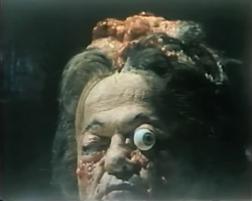
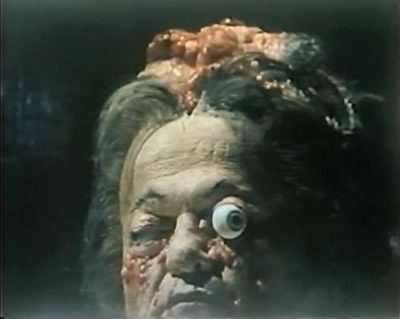
The way the virus kills is unsettling, although I was a bit disappointed that there were fewer gross-out moments than I’d expected. While a couple of the effects-shots are impressive, this is ultimately a much tamer movie than the single frame above implies, so set your expectations accordingly.
Luckily, I found that the aspects of this film that I enjoyed (having an innovative scenario for its time, Jenny’s arc, and the few well done SFX shots) slightly outweighed the parts I didn’t like (the dumb portrayal of science, the silly government, a cast of paper-thin characters, and the fact that it was light on the gore). I’d recommend this to anyone who’s in the mood for a vintage sci-fi tale in the vein of a Twilight Zone episode, or to folks who wish those guys down in front during Mystery Science Theater 3000 would quiet down so you could enjoy the show.