



This review was originally written for the Wisconsin Film Festival. Poetry will show in the Sundance Cinemas Screening Room starting tonight.
Is the first night of the Wisconsin Film Festival too soon to claim a favorite film? When the end credits rolled for the South Korean film Poetry, I was sitting stock-still in the back of the Wisconsin Union Theatre trying not to cry. Twelve hours later, I was still thinking about it.
You could say that Poetry is the story of a 66-year-old grandmother, Mija, and her quest to write her first poem for a class at a local community center as she struggles to make ends meet financially and also raise her 15-year-old grandson. You could also say that it’s the story of a community that, faced with the suicide of a girl who has been repeatedly gang raped, chooses silence over the punishment of the teenage rapists.
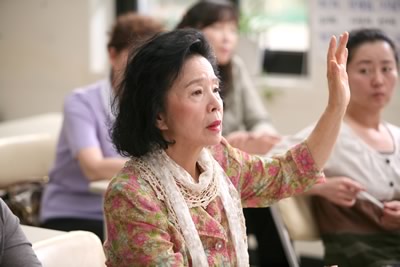
Mija is our guide throughout, though we often see her as others must – a poor, but extremely dignified woman, who dresses “chic” despite her limited means and, by her own admission, says odd, often inane, things. Things happen to Mija, and she often seems like a helpless passenger in the events of her own life. When she speaks, others ignore or disregard her, including her grandson, a sullen boy who eats her food and plays his music far too loud. Her expression is often one of seeming haziness, and we later learn she is in the early stages of Alzheimer’s.
Set in a large town in the mountainous countryside near Seoul, the film is ever and always visually gorgeous. Mountains, rivers, and wildflowers follow Mija’s quest to find the poetry that, as her poetry teacher tells her, “everyone carries in their heart.” We see her on bus rides past farms, and ambling along brooks, an eccentric, fairy-like character in a white hat.
On that note, it’s uncomfortable to see a person pursue “being a poet” as if writing well only requires staring at flowers and rivers. Mija’s notebook is its own character in this movie – we see her inspired scrawlings big on the screen, and despair with Mija of her ever writing something really good. When we hear the poem she does write, (as you know must happen in any movie where a person has been told to create something), we see these awkward fragments, along with Mija herself, resolved into something entirely different.
But really, I think director Lee Chang-Dong wants you uncomfortable, both with Mija’s too-fervent pursuit of art, and with the rape of the girl, who, we hear, was “short and plain,” and whose victimization is a thing to discuss over beers (“to lift the mood”). As an audience member, I wanted characters to say what I would say, and never once did that happen. At times, the silence, and the domination of the conversation by men, was too much to bear, and I shifted in my seat many, many times. At a time when the New York Times is printing stories about rape that seem to place the blame squarely on the victim, filled with hand-wringing about the damage the crime has done to the rapists, this movie is shockingly timely. I can’t say the end is satisfying, but it is, in all senses of the word, poetic.