



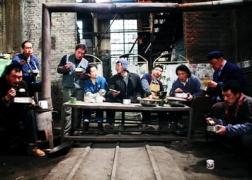
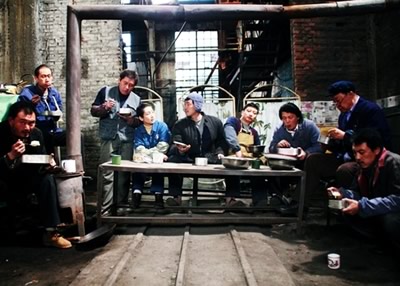
A musician and steelworker, Chen, is being divorced by his estranged wife. Their daughter, Xiao Yuan, will go with whichever parent can buy her a piano. Chen cannot afford such a luxury, but he is determined and scheming, and embarks on a quest that includes his singer girlfriend, worker friends, and the members of his band (they play mainly Russian music). Spontaneous, often surreal, musical numbers, zany capers, and gorgeous shots of the crumbling industrial city lead us, in the end, to an unexpectedly sad resting place.
The preview summary of the Chinese film compared it to Full Monty, but without the stripping. I admit, this is one reason I decided to see it. And I could see echoes, in the striving of a group of men made economically obsolete to recover a sense of dignity. “We workers can do anything when we put our mind to it,” says one old engineer, when they consider the idea of building Xiao Yuan’s piano from scratch. “We should always try.”
Through Chen, we come to care not just about Chen’s family problems, but the decay of his entire world. The iconic smokestacks of the local foundry frame even his romances, and yet someone – we never learn who – has decided they must be demolished. His friends are all either out of work, or not working enough, and must at times consider illegal activities and petty cheating.
The cinematography also reminded me persistently of the photography and “ruin porn” coming out of American cities, especially Detroit, these days. The city, made even more barren by the winter season, is a landscape of broken windows and nearly empty movie theaters, roads with no traffic, and long, loving shots of rust, rubble and dust that dwarf the human beings moving through them. The factory is as much a character in this movie as the piano Chen seeks, or even Chen himself. And it is beautiful.
Though the movie leaps from funny to sad rather suddenly at times, it never once feels off. Even the musical numbers, which at times reflect symbolic rather than literal realities, come off seamlessly, without a hint of corniness. The audience laughed and murmured with equal volume, and the applause at the end was hearty. It’s only the second full-length film by director Zhang Meng – I am excited to see what he does next.