



When I arrived at the Bartell Theater Friday night for the 6 p.m. screening of Monica and David, the line for rush tickets was almost as long as the line of people who had purchased tickets for the sold-out screening. This surprised me mostly because I don’t associate documentaries with crowds.
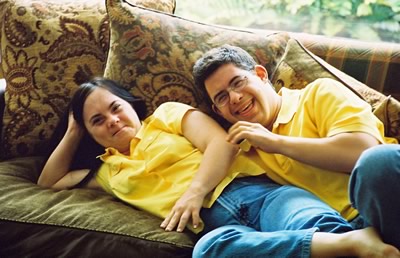
The documentary follows a year in the life of Monica and David, two young adults with Down syndrome, as they marry and begin their life together. This is a new challenge for a group of people who, in the 1980s, faced an average life expectancy of 25. Now, it’s closer to 60.
The documentary is light on narration throughout, and we learn most biographical details from interviews with Monica and David's parents. Meanwhile, fly-on-the-wall footage leads us through the routines and events of their lives.
The pair are so in love, and it's such a joy to watch them enjoy each other. I am not usually a person who finds weddings touching, but the footage of theirs is really, really special. There's no hemming and hawing about the significance of the event. As Monica says, "It's all about him, and all about me."
After the wedding, David and Monica remain living with Monica's mother and stepfather, though they are clearly hungry for independence. David wants a job at a local grocery store, and his mother, wanting to protect him from people who would mistreat him, says no.
A common theme is the question of dependence. Monica’s mother, Maria, who raised Monica alone at a young age, says shortly before the wedding, “Monica is my life’s work.” She carries this devotion and sense of duty throughout, but at times, we see holes where the logistical and emotional difficulty of constant parenting shine through. We soon get the sense that they are unnecessarily limiting their children, whose adulthood, though a gray area at times because of their disability, is still real and in need of acknowledgment. The question of what the pair will do when their parents are gone, too, looms large, even as they fold laundry together and celebrate victories like David, who is diabetic, learning to manage his insulin injections on his own.
Maria, in a moment of epiphany, explains that it is parents' desire to protect their children from a less understanding world that leads them astray. “We are the first to deny their rights,” she says.
I really enjoyed this film, as a chance to see a side of life that many people don't always have an opportunity to understand. The film shares the funny and tender as well as the sad or frustrating, and, again, Monica and David have a clear hunger to be out in the world as independent adults. Because that's how life is. Even better was the post-film Q&A, which included several Madison residents who themselves have a disability, and who said that the disabled are routinely underestimated. "Over and over again I've seen myself and others prove other people wrong (about what we can do)," said a young man who has cerebral palsy. "We want to be treated like anybody else."