



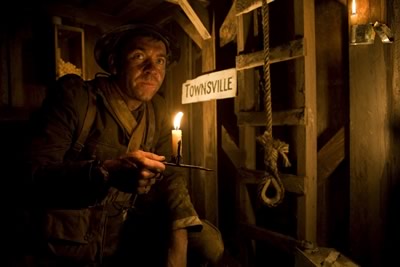
Square jaws, square shoulders ... Beneath Hill 60 is as square a movie as has ever played at the Wisconsin Film Festival. Now, squareness cuts both ways -- this WWI picture is conventional down to its very bones, but it's also a handsomely set gem of classical filmmaking, and delivers its upbeats and downbeats with conviction; the first casualty whose death we truly mourn is portrayed in a truly dynamite, pure-cinema kind of shot. (My colleague Matt has more to say about its filmmaking virtues.) The movie cuts between Capt. Woodward's arrival at the Western Front as the new commanding officer of a mining unit charged with burrowing beneath the German line, and flashbacks to his days in Australia as he decides to leave his supervisory job at a copper mine and join the army. The movie won a prize from the Alfred P. Sloan Foundation, which awards movies that deal with scientific and technical issues, and the movie was selected by the Wisconsin Film Fest to draw in enginerd moviegoers (a number I count myself among; in her introduction, festival director Meg Hamel also noted the three generations of Wisconsin engineers in her family).
Thinking about this movie's appeal to a technical audience provides one of the most useful vantages for peering under its hood. How can a movie incorporate scientific content? It can show science in action, it can show scientists in action, and it can probe into the morals and ethics of how science is applied.
The first two, showing science and scientists in action, is the purest and, in some ways, least pure approach. Until you get to that third path -- asking questions, incorporating that science into a story's meaningful undercurrents -- then simply stapling science content onto the movie is just like stapling anything else onto a movie, and the popular shorthand for that approach is to call it pornography -- we might refer to a movie as real estate porn, or torture porn, or shopping porn.
Science proves a particular problem here, because often, science just is. Let me start with a counterexample -- at one point, Woodward is trying to slowly and silently pry out a brick behind enemy lines, and one of his men instead throws a stone some distance away from them; the cover fire this diversion creates allows his man to expediently kick in the brick façade. This is a clever, character-revealing bit of problem-solving; we understand the men and their relationship better.
But when, for instance, Woodward's superiors insist that there's no way that he can pump water up 90 ft. to expel it from the mine, and Woodward counters that modern pumps are indeed capable of that load, then, sure, there's a jolt of protagonist-vs.-bureaucrat pleasure when the water finally gushes out. Unlike kicking the bricks, though, it's not story-clever; having the technical and professional acumen to know about the latest in pump technology is a rather meager virtue from a narrative standpoint. While the pump is merely one element of Woodward's ingenious plan, the ingenuity is engineering porn -- it takes us out of the story, rather than reveal something about the characters. Characters are what make stories work, and that's why scientific exposition can be hard to smuggle in.
For as classical as Beneath Hill 60 is, then, it lacks one thing we always associate with Hollywood movies, and that's the protagonist who changes, who learns something over the course of the movie. Woodward is pure professional; we know from the Australia flashbacks that he's a highly regarded mining expert, and who considers his ability to help get copper out of the ground to be critical to the war effort. Prodded on by the father of the woman he loves, he becomes convinced that more direct service is required, and he provides it. He's a very warm CO, bunking with his troops rather than in officers' quarters after rough spells -- he's deeply likable to them and to us (and expertly played by Brendan Cowell -- apparently Oceanic actors all come from the same genetic stock, because depending on the light you can see Russell Crowe and Guy Pearce's features in his face).
But we should mention what Woodward's big project is. They need to pump the water out the mine to dry out the buried explosives under Hill 60 that, when detonated, will be the largest man-made explosion ever, to be triggered when the German forces atop the hill are maximally swelled. Now, obviously there's no beef to be had with the defeat of the Central Powers in WWI, and the use of science to reduce the risk of casualties on our side. The movie, however, is a story about Woodward doing this, and at its climax (spoiler for the rest of the piece, sorry) it poses a big moral question to him -- he can either deploy the bomb at the time that has been tactically determined to be most effective, or he can delay the few minutes necessary to save a member of his company who got caved in. With big, remorseful eyes but a stiff upper lip, Woodward presses the button. As we've known throughout the movie, and as he proves again here, he's the consummate company man.
It's not that it was the wrong decision; it's that the story is wrong to portray it, or rather to not make it the culmination of Woodward's character development. When we flash ahead to his wedding to the town beauty a decade his junior, with his eyes dewy as he recalls the comrade lost in the big explosion, it's counter-sympathetic -- we feel less for him. And while the explosion was successful in killing 10,000 German troops, we learn in the closing titles that Germany recaptured the hill later in the war; of course, they went on to lose the war; of course, World War II is only a few decades in the offing, etc. Those are the facts of the case, and there's no debating them, but it can't help but make the dulce et decorum est sentiments it has cultivated turn a little ashy in your mouth. The big explosion is indeed awesome, in the vengeful-God sense more than the Schwarzenegger-just-bazooka'd-the-terrorists'-yacht sense, but shortchanging the characters' engagement with the moral and ethical questions in order to highlight the engineering porn makes it less than the story it ought to be.