



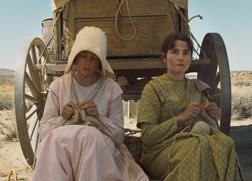
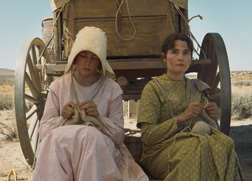
The first language in Meek's Cutoff occurs five minutes into the movie, when one of the settlers on a wagon train carves "LOST" into a bleached log. The first spoken language occurs five minutes later, when the child in the train reads aloud from Genesis, about Adam and Eve's exile. The first dialogue occurs another five minutes in, as two characters on a late-night walk debate the merits of their guide, Stephen Meek, who has been contracted to lead them west to a wished-for Eden.
I think that alone qualifies as a sufficient screener to gauge your interest in this movie: Regardless of how well-made it might be, can you see yourself being engaged with a movie about beardy men and bonneted women trudging along, and no one talks to each other for the first 15 minutes? If yes, you are likely to love Meek's Cutoff, because it is an ambitious and meticulous work built to be appreciated by those who will appreciate it. If no, get rid of your tickets, because you'll spend the whole time wondering where the emperor's clothes went.
Kelly Reichardt made her name directing minor-key character pieces like Old Joy and Wendy and Lucy; Meek's Cutoff is a major step forward in ambition, a multifaceted act of time travel. Not only has Reichardt successfully evoked the 19th century on a shoestring production budget, but she's also making a throwback movie, evidenced most plainly in her recherche choice of the 4:3 aspect ratio, a.k.a. that squarish shape you associate with old pre-widescreen movies and pre-HDTV. She uses the uncommon canvas magnificently, keeping blocking tight, hiding information offscreen, and reminding us all what Westerns used to look like.
This is all in service of a story where a small handful of aspirants, played by Michelle Williams, Will Patton and others, have been led away from home by Bruce Greenwood's Meek to seek their fortune. Meek talks a good game, but: The movie opens on the wagon train fording a stream and refilling their buckets and barrels with fresh water, and from that point forward, the characters and the audience spend a lot of time wondering whether they'll ever find water again. (The movie has a number of odd similarities to Rango, most central of which is that you want to make sure you're well hydrated before the curtain rises.)
As the expedition dries up, so do their hopes; the best shorthand for the movie's events is a mash-up of old-school TV with an old-school computer game: "The Monsters Are Due on the Oregon Trail." Fear, recrimination and paranoia run high, with Williams and Patton's characters defending the beachhead of reasonableness. When the party comes across a Native American, only those two have the kneejerk reaction to not regard him as a scheming saboteur; Meek wants to kill him on the spot.
This is the heart of the movie, and while it's a beating heart, damned if I can quite take its pulse. The sardine-packed audience was pin-drop silent for the movie; the most voluble gasp of the night came when the movie faded to black, and then to credits -- everyone wanted more resolution. In fact, I wonder if that's not an easy way to distinguish who liked the movie and who didn't: If your spider-sense didn't tell you that the last shot was going to be the last shot before it faded out, then the movie as a whole may frustrate you. It makes its opening salvo quite plain -- lost people, doomed to toil, seek a better life but have to cross the desert to get there -- and there's even a Biblical rhyme with the movie's last location, but is that the tree of life, or a perversion of it? Within the troubled wagon train, one philosophy rules the day, but to profit or to ruin? I was rocked by the filmmaking on a scene-by-scene basis, but less than shaken by the movie's profundity.