



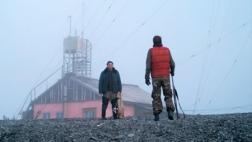
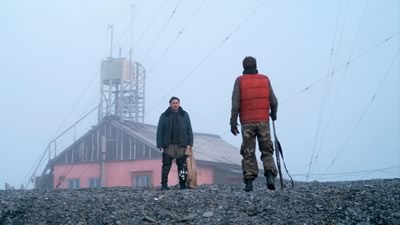
I know from fest director Meg Hamel's tweets that, since last year's fest, she watched all of LOST. It makes me wonder when she watched How I Ended This Summer with respect to that show, because for the first 15 minutes I was convinced the movie was taking place at some Arctic Dharma outpost -- one character points to an unknown building on a map of their island, which turns out to be the abandoned Fog Station; the other character speaks a string of numbers into a radio and transmits them across the island, an activity these two must perform with sleep-interrupting regularity. And did I mention the polar bears?
But unlike LOST, How I Ended This Summer is a straightforward story, and deeply parable-like in its intentions. Pavel (Grigory Dobrygin) is stationed on a remote island with Sergei (Sergei Puskepalis) to take telemetry readings, and they can't quite get comfortable with one another -- Sergei is a long-timer who, in a surly moment, derides the youngster's presence as merely looking for an original "what I did on my summer vacation" essay. But then the plot creates a scenario where Pavel must say something difficult to this proxy father, and when he doesn't, the movie becomes a study in what happens after That Moment passes. For a while, this avoidance become an exercise in cringeworthy black comedy, but then the other shoe drops and the movie turns bleak and spooky.
It's bleakness and spookiness done in high style. You've perhaps heard that to be accurate, the Oscar categories should replace "Best" with "Most" -- Most Acting, Most Editing, Most Visual Effects. This Russian movie will never be in an Oscar race, but it would contend with the heavyweights for Best/Most Cinematography, with magisterially composed shots of majestically desolate landscapes. It's Arctic, but with a color scheme of green and black rather than white, and traces of humanity often literally as diminutive as can be. Director Alexei Popogrebsky is a lingerer -- you get lots of long shots, with every additional frame expected to freight in that much more meaning, but by and large it works.
The script, also by Popogrebsky, is tightly coiled, meticulous in its structure and callbacks, but there's nothing meta at its core, no mystery to be revealed except how dark Pavel's dark night of the soul will get (although I would have liked a better sense of whether we're to think Pavel's callowness is specific to him or to his generation; I found that initial motivation underdone). At the Berlinale, Dobrygin and Puskepalis jointly won the Best Actor award, and there's no better compliment the film could receive; each performance truly is only as good as his co-star's. If a wrenching drama, beautifully shot and acted, is your idea of a good time, then How I Ended Your Summer is one worth catching on the big screen.
Tickets are still available for both the Friday and Sunday screenings at the Orpheum Stage Door.