



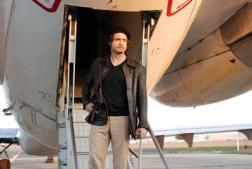
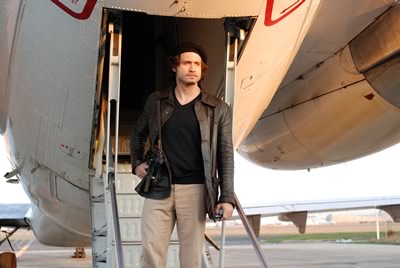
It's great when a film festival has one central feat of endurance, a la last year's Red Riding trilogy, and this year it's the 5½-hour screening of Oliver Assayas' Carlos. If you're considering taking Friday off work, you should know that there may never be an easier year to earn that He-Man fest badge, because those five hours fly by. In fact, no film at the fest may deliver more conventional moviegoing pleasure, because Carlos hits all the bases: A beautiful star that draws the eye, action, intrigue, sex, scenery ... all in the service of the world's worst genre, the biopic.
And Carlos even belongs to that worst subcategory of biopic, the kind that trots out its subject's whole life. But at 321 minutes, the story of notorious terrorist Carlos the Jackal gets enough room to breathe, and Assayas puts in the effort to actually dramatize every scene -- there's always something at stake, cross-purposes being pitted against each other, a psychological insight being wrought. Yes, Carlos' mercenary career committing terror acts to further anticapitalist causes is punctuated with gunshots and bomb blasts, but it's the storytelling and performances that really give Carlos its momentum.
The following is going to sound like spoilers, but really it's not: It's just something to think about before you dive in. The central axiom of filmmaking is "show, don't tell." In our five hours of being shown Carlos' life, Carlos -- in a justly lauded performance by Édgar Ramirez -- tells us many things; he explains and explains his motivations for his actions. But should we regard those explanations as something the movie is telling us, or as something that the movie is showing us? You can take Carlos' statements at face value -- certainly, there are no scenes where Carlos further explains that he had ever been disingenuous -- but it's smart to view them instead as actions to be compared and contrasted with Carlos' other actions. That's not to suggest, for instance, that the character is insincere in his oft-stated desire to see the oppressed overcome the imperialists, but you're not going to get a scene where our hero cradles the body of an impoverished child and looks up with tearful beseeching as the camera above him pulls back. Even when Carlos speaks most candidly about his beliefs -- "Marxism is my only religion; it's in my blood" -- it's to a reporter, who chides him that Carlos only exists if he gets news stories written about him.
So with that in mind, as you watch the movie, consider a critical scene that takes place at almost exactly the halfway point: Carlos makes a decision that, from all evidence, is necessary to save his life. Carlos spends a lot of time explaining that decision; he justifies it persuasively. But, for the rest of the movie, he's on tilt. Was it the rational, selfless act he wants everyone to believe, or a rational, selfish act whose motivations he can't bring himself to express? Would his death have been the "right" action at that time, the proper ending to his story, if only to spare himself from the second half of the movie?
Don't get me wrong -- for viewers, the third act has some of the movie's meatiest scenes. But we learn early on that Carlos' primary thrust is pelvic in nature. His professional façade is pure superego, but his love life is pure id, and Assayas, Ramirez and screenwriters Dan Franck and Daniel Leconte dramatize that push/pull so we can determine which really drives Carlos. Assayas' perhaps unflattering thesis is that Carlos' brand of revolution is a product of arrested development: to believe that you can treat women so shabbily is like believing you can unseat a superpower's influence through righteous violence -- a boy's delusion.
Anyway, food for thought, and maybe you'll glean a totally different thesis. Carlos is a good enough movie for different viewers to find different meanings in it. But I think a common chorus might emerge from the screening: festival favorite.
Tickets are still available for the Friday 1 p.m. screening at the Wisconsin Union Theatre.