



I admit it’s been a while since I’ve written for Dane101, but writing, PR, and fight work for You’ve Ruined A Perfectly Good Mystery! took up enough time to pause film reviews and the Film101 podcast. Co-writer and Dane101 contributor Christian Neuhaus has covered the show in multiple excellent articles. I certainly could write several collaborative-blog-for-Madison-Wisconsin pages worth of material myself. I learned a hell of a lot from this experience, so present my take in the form of unsolicited advice. The show taught me good lessons, much of which I already expected, but had solidified as definitive advice. Like all advice, you can take it or leave it, but most of all I encourage you to contribute your own in the comments.
So, in no particular order, here are some tips to create successful screen or stage play based on my contribution to Madison’s first fully-interactive steampunk detective play.
1 Write What You Know
You need to practice like crazy to be good at anything, and writing is no different. Odds are there are certain stories or genres that you’re better at than others. If you want to work on your weak points, you should, but if you want to produce something, write what you’re good at. Christian and I both have experience with comedy, and it’s what most people know us for (see point 3). As a fight choreographer I knew I could write in fight scenes and be able to pull them off. Other elements of You’ve Ruined A Perfectly Good Mystery! fell in our ken – parody, low-budget shows, meta humor, and totally-not-Sherlock Holmes detective stories. Simply, we know we can make people laugh, so we wrote a comedy.
2 Don’t Be Afraid to Take Risks
There’s advantage to staying in your comfort zone, but the audience doesn’t always want to be there. They want something new – so long as it works. I couldn’t bring myself to directly say ‘taking a risk is risky’ in an article about writing advice, but you get the idea. A play can’t stand alone on a gimmick, but innovation gets noticed and gets remembered. We were taking a chance with our audience-driven structure. But we tested the waters in our Blitz short, I have experience writing interactively (see point 1), and someone might have promised the theater that 100% of the shows would sell out (see point 7). Not only did the choose-your-own-adventure pay off, so did the puzzle-solving. Hell, we even had people cheering at clever use of anagrams. What nerds.
3 Establish Yourself as A Good Writer
Your bigger projects will get picked up easier if you prove that you can succeed with smaller projects. Plus, getting there really is half the fun. You can have a blast, practice, and experiment with scripts that are seen by very few people.
As a case study, before getting our full length play produced, I did the following theatrical writing:
• Write one-minute plays for Short Shorts (which accepted scripts from all writers). Successful shows got me invited to:
• Write for Blitz. Successful shows got me invited to:
• Write for Blitz Smackdown. Successful shows generated buzz and goodwill for You’ve Ruined A Perfectly Good Mystery!.
This doesn’t include the screenwriting, journalism, and other projects I have done to make connections and practice my craft. This very website has been a great help in this regard. Don’t overlook that point about connections. Some actors said they weren’t planning on auditioning, but then saw our Blitz Smackdown winner and decided they’d try working with us. Others auditioned for a chance to work with our director. Nothing sells your success like past proof of it.
4 Establish Yourself as a Good Person
You have to be a true genius to get away with being an asshole and having people still work with you. There are very few true geniuses living among us, and possibly none in Madison. Christian and I earned a reputation as adaptable, easy to work with guys who have passion but don’t cause drama. That actually went a long way. Experienced, talented people went to bat for us because they knew we would work hard and be team players. And those who disagree with that assessment probably won’t work with us (and thus lost the once-in-a-lifetime opportunity to be part of a mime fight and anagram-based verbal sparring).
5 Structure
This is the part of the writing advice post where I actually talk about writing.
William Goldman’s old saw ‘story is structure’ is spot on. We structured the hell out of this play. That script was so damn structured we needed architectural licenses to write it and proper zoning permits to print it. Our entire first writer meeting, which lasted an entire evening, was only about structure. Obviously this was critical for a choose-your-own-adventure; we needed to make sure every path had a sensible plot, good pacing, character arcs, and clues that added up, regardless of decisions. Standard three-act stories need it just as much.
Does your script have a beginning, middle, and end? No, really. Check and make sure. Does each scene logically lead into the next? Does each scene further the plot or further character development? Are there clear turning points, a climax? Is it paced properly, with an engaging level of action, pauses in the right places, and forward momentum? Even jokes need structure, with proper setups, punchlines, and callbacks. (I might nominate You’ve Ruined A Perfectly Good Mystery! for most callbacks in any show, for better or worse).
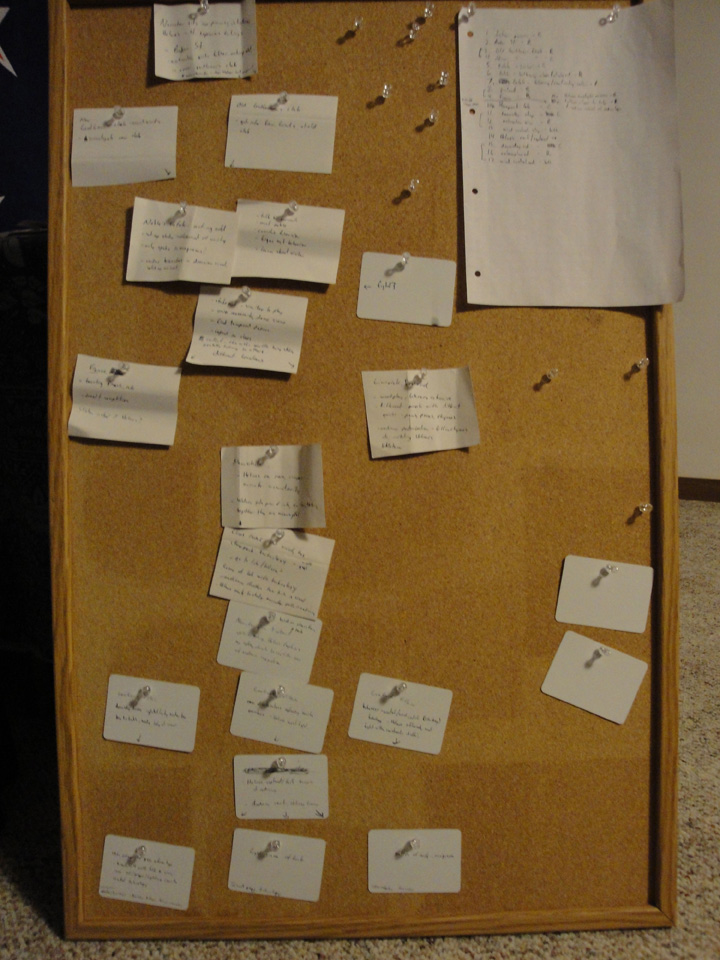
We outlined and used a corkboard with scene cards for ours. I still have it standing next to my computer to remind me of the importance of story structure. There are excellent books and online material available if you’d like to improve your grasp of structure. Narrative plays and movies need structure. If you disagree, you should write poetry.
6 Rewrite
Then rewrite again, and again, and again. Then punch it up. Then punch it up again.
You’re going to go through a lot of drafts, and that’s good. If you’re not, your script isn’t as good as it could be. I know. I’m generally terrible at this. I have a blast of inspiration, slap it all on the page, and sit back smugly. And at best, I have a mediocre script. This show taught me the importance of rewrites.
Again, for a case study, our process went something like this:
• Brainstorming meeting, then structure meeting
• First draft pieces (scene by scene over several weeks, back and forth, using Google Docs)
• Read and edit each other’s scenes; rewrite scenes based on notes
• Compile first draft
• Read, edit, and rewrite into second draft
• Bring second draft to reading (Mercury actors kindly volunteered their time; see point 4)
• Major rewrite based on read-through
• Have director read this third draft and give notes
• Rewrite to fourth draft based on director notes
• Reread and mark up the entire script ourselves, refine into fifth draft
We didn’t stop there. We were updating the script during rehearsal based on reading our own work and ideas from all involved, all the while keeping in mind point 5. Note that this generally isn’t recommended, but as our show was new we all wanted it to workshop it into the best show it could be. Which is recommended - but I wouldn’t tell a producer that the script is fine because you’ll fix it in rehearsal.
7 Have a Giant Pair of Brass Balls
My co-writer might translate this one as “confidence.” Whatever you call it, believe in yourself. Be passionate about your work. Let others feel that passion. Know it’s good, and tell people it’s good. Promote yourself and your work. Christian and I put in almost as much work as the wonderful, actual PR team, and it paid off. Combine this with points 3 and 4, and you can be a nearly unstoppable force. Truly unstoppable with a good script in your hand.
I believe this last little piece of advice was the difference between our script being produced and not. We had followed all the advice laid out here and had a good piece of writing, but paper doesn’t shamelessly promote itself. Accost people at parties. Brag to them in bars. Grab them by the lapels while also holding two beers and swear you will deliver the greatest piece of fiction this stupid world has ever seen. Maybe not that last one. There’s a fine line between confidence and cockiness, and I’m too awesome to tell you what that is. I really did sincerely promise that You’ve Ruined A Perfectly Good Mystery! would sell out every show. It did.
If all else fails, find a good co-writer.