



"In the Next Room or the vibrator play" has a title that suggests a broad, bawdy sex comedy. What the Forward Theater Company brings instead is a unexpectedly gentle and heartfelt play about longing and intimacy.
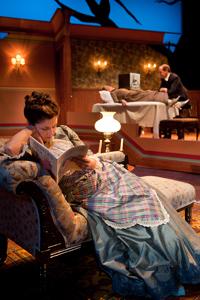
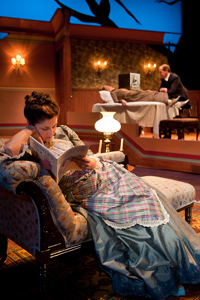
Dr. Givings (Mark Ulrich) is a highly successful doctor, specializing in the treatment of "hysteria," a Victorian Age diagnosis given to women who found themselves straying outside of the happy, docile domestic role they were expected to play. The treatment for hysteria included, among other things, external pelvic massage. The theory was that an orgasm, or "paroxysm," would help to remove uterine congestion, resulting in relief from the symptoms of hysteria. As might be expected in a society where sexual matters were rarely discussed, and often in the most negative of ways, this process could take as long as hours. However, as the Age of Electricity dawned, efficiency came to medicine the same as it came to most other things. The vibrator was created as a medical instrument that could induce an orgasm in mere minutes. Dr. Givings, enthusiastically embracing science and new inventions, owns one of these machines that he uses in his "operating theater," the titular next room.
With a vibrator being so central the play could easily become mere titillation. But director Jennifer Uphoff Gray minimizes this aspect of the play, as the use of the vibrator is kept hidden under medical white sheets. Furthermore, this is entirely in keeping with the approach taken by playwright Sarah Ruhl, who mines a great deal of humor from how these pre-Freudian characters are so incredibly innocent to their own emotions and desires. Dr. Givings' wife Catherine (Jessica Bess Lanius) even sits in the drawing room outside the operating theater, seeing her husband giving another woman an orgasm as nothing more than a medical procedure.
Early in the play, Catherine states that she doesn't know what kind of person she is, something shared by all of the play's characters. But electricity here is a metaphor not just for the changing times, but of changing minds. Just as electric light illuminates the darkness, so does the vibrator shed light on repressed emotions and needs. Dr. Givings' newest patient, Sabrina Daldry (Karen Moeller), worries that in the harsh glare of the electric light everyone will appear to be monsters. What they are instead are people with passions running deeper than they ever knew.
"In the Next Room" runs almost two-and-a-half hours, and it is a credit to Gray's direction that the play's pacing never drags. For a show dealing with such heady themes, "In the Next Room" is a very funny work that organically derives from the most taboo of subjects. But this quick pace sometimes works against the play. Characters come on and offstage as if they're in a French farce, one character appearing immediately as another leaves. The play rarely gives time to let individual moments breathe. This has the effect of flattening the characterizations, and the actors at times feel like they're playacting types instead of deeply feeling their characters. Ryan Schabach as a patient suffering from rare male "hysteria" in particular seems to be representing the part of the "sensitive artist." But when the play pauses just briefly to let the moment sink in, the effect is powerful. A scene where Catherine asks her husband to use the machine on her while he kisses her, and he refuses as a "man of science," acutely captures Catherine's newly-discovered frustrations and charges the air. A similar scene where Catherine's wet nurse Elizabeth (Marti Gobel) talks about her mixed feelings feeding another woman's child while her own is dead, also benefits from letting the moment sink in.
The final scene of the show would normally strike me as being unbearably hokey. But "In the Next Room" earns a lot of goodwill through its characters' earnestness. Even as the music swells, I could not maintain an air of cynicism. Through these actors, particularly Mark Ulrich and Jessica Bess Lanius, these characters had taken an emotional journey from darkness into (electric) light. What we end with is two people who had grown apart coming back together again, more intimate than they ever had been before, vulnerable and human. In the end, "In the Next Room" isn't about electricity or vibrators or staged orgasms. It is about intimacy, something far more personal than a simple sex show could ever hope to comprehend.
"In the Next Room; or, The Vibrator Play" runs through Nov. 21 at the Overture Center's Playhouse. More information and tickets can be found here. Photo by Zane Williams.