



Whatever time you cast your election ballot on Tuesday, the post-election parties and ballot watching will go on far into the night — which means you have time to get over to the Music Hall and catch the final UW Opera performances of Puccini’s “Suor Angelica” and “Gianni Schicchi.” Their performance on Sunday afternoon was just the latest evidence that Madison music lovers enjoy an embarrassment of riches almost year-round.
I skipped opening on night on Friday so that I could see the Wisconsin Chamber Orchestra, and this coming Friday, Madison Opera opens its fiftieth season with Mozart’s “Marriage of Figaro.” But UW Opera includes in its mission statement that “Uncommon repertoire is stressed.” Right on. It’s great to have “Figaro” available, but the fact is very few houses, save the Metropolitan Opera in New York City, will stage Puccini’s “Il Trittico,” the 1918 trilogy of one-act operas that opens with “Il Tabarro” (not included in this UW production).
But “Angelica” and “Schicchi” work well as a pair, the former being a slower-paced, semi-dreamlike “miracle story” set in a late 17th convent. Celeste Fraser was in the title role (Lindsay Sessing will reprise her opening night performance on Tuesday), and delivered a vocally confident reading and an acting job that carefully avoided easy melodrama and sentimentality.
The story concerns a young nun who was forced to the convent by her aristocratic family seven years earlier after giving birth out of wedlock. Finally receiving a visit from her aunt, with instructions to sign away her share of the family fortune, Angelica learns that her son (“who I saw and kissed but once”) died two years earlier. Devastated, she drinks poison, only to despair at the realization that she has committed a mortal sin by taking her own life, and will not join her son in heaven. But as she dies, she sees a vision of the Virgin Mary and her son as she leaves her earthly life.
Or at least that’s what the original libretto says. Director William Farlow here relies on Fraser’s ability to create a facial transformation from hopelessness to joy in just a few moments. It cannot be said with any certainty whether Farlow is making the point that perhaps Angelica doesn’t really see the vision or not — certainly if Fraser’s acting is the deciding factor, then Angelica does experience forgiveness as a reality.
As the aunt (“Principessa”) Kathleen Otterson brought the kind of veteran stature and experience that is an essential glue to truly successful university productions of major works. She also provided a reminder that the costume designers are penned in by the setting: the whole cast is female, and save for the aunt, all nuns and novitiates. Otterson alone donned a different costume, wearing the kind of austere but rich dress that brought Dickens’ Miss Havisham to mind (minus the cobwebs, of course).
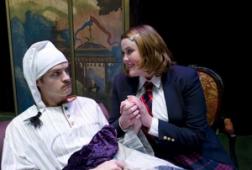
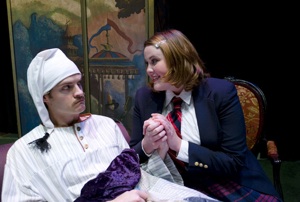
“Schicchi” was a hoot — and is meant to be. The story of a selfish family lamenting being disinherited by their just-deceased relative, who are then outwitted by the title character whom they look down upon, is the operatic version of a scherzo: fleet, pulsing with energy and unexpected accents, and in this case, resulting in much audible laughter.
Here Farlow (who “cannot count the number of productions [of “Schicchi”] I’ve directed”) brings all that experience to a willing cast and they bear much delightful artistic fruit. Megan Gryga as Lauretta gets the one big hit tune moment (“Mio babbino caro”) and nearly made the most of it. Otterson was amazing via the juxtaposition of the imperious aunt in “Angelica” with the quasi-frumpy and hilarious Zita.
Originally set in Dante’s Florence of 1299, Farlow set the tale in the 1950s, and it worked very well. It also gave costume and hair/makeup designers Sydney Krieger and Hyewon Park plenty to do. There was everything from a beanie cap and loud plaid vest to Zita’s Edith Bunker-like dress and Schicchi’s “Mr. Rogers” look.
The orchestra, under James Smith, really seemed to relish the popcorn popping energy of the score after the relative languor of “Angelica,” and numerous details of Puccini’s scoring emerged with point and clarity.
Apparently there were a large number of people more concerned with an artistic endeavor than the Packers’ game, as the Music Hall was nearly filled save for the upper side balconies. Here’s hoping even more people will immerse themselves in this worthy diversion on Tuesday while others are counting the votes.