



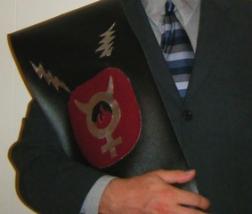
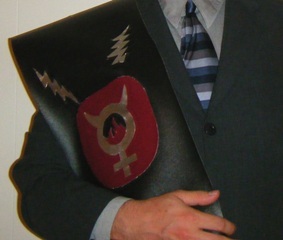
I suppose you’re wondering how I, an ordinary man, came into the extraordinary circumstance of winning the Smackdown belt in Mercury Players Theatre’s 2010 Blitz weekend: where plays are written and readied for performance within 24 hours. There were a number of things to make the fourth Smackdown one like no other, such as the inclusion of Blitz pioneer Buck Hakes in the group of writers, a requirement to write cameo appearances for a pair of actors that would be appearing in all five plays, raiding MercLab for props, and a whole lot of dancing. At least one knowledgeable source thinks this was the best Smackdown yet.
Preliminaries
As with last year, I co-wrote with Rick Stemm. The other returning writers included Rob Matsushita, Megan McGlone, and Doug Reed. Thursday night, 24 hours before the curtain would be going up on the first play, writers and directors met at the MercLab for assignments. Unlike last year, the writer-director assignments were done randomly and Rick and I were pleased to be working with someone we knew fairly well: Bonnie Balke, whose impressive credentials include producing previous Smackdowns and who will be stage managing You’ve Ruined A Perfectly Good Mystery (auditions June 27 and 29, 7 p.m. at MercLab, 930 Fair Oaks Avenue).
The next step was to draw two titles, which this year were taken from textsfromlastnight.com. The word or pair of words that we were to use as the title were highlighted in the text, and we also had to incorporate the “spirit” of the entire text in the action of the play. The two I drew were “i just walked into a room at this party and someone yelled ‘dibs!’” [title: Dibs] and “just found a shoebox labled ‘emergency smoking box’... it has a lightbulb, 2 potatoes, a dried up flower, and a button that says ‘stop drop and roll’. what did we do last night?!” [title: Smoking Box]
Next was actor selection. This year, as was the case last year, the actors in the cast were going to drive much of what happened in the script. The order of selection was determined by drawing playing cards and once again Rick got us first actor pick, expressing our jubilation in a proclamation that had more instances of the word “motherf--ker” than were strictly necessary to get the point across. Between Rick, Bonnie, and me we had a good level of familiarity with most of the available actors and, with producer Pete Rydberg enforcing a brisk pace, we selected a cast with great potential: Mary Fairweather Dexter, Brendan Hartmann, Martha E. White, Colin Woolston [a three-time Smackdown draft pick for me], and Christopher Younggren. Beside the actors we picked, all writers had to create small but pivotal roles for Schwag (who directed my first Blitz play) and Elliot Schulz (who acted in Blitz plays written separately by Rick and me).
What followed was something new: Pete gave the writers each a box and invited us to take whatever props from the MercLab would fit in it, for potential use in our plays. He gave Rick and me the added stipulation of not talking during the time we were collecting the props, which for me is standard operating procedure but must have been like Kryptonite for Rick. A more difficult challenge would have been him staying silent and me having to talk constantly for twenty minutes. Bonnie, Rick and I were sort of generous in our definition of “fit in” with respect to the box. Among our items were a gas can, a couple of angel wings, a general’s outfit, a Mr. Wonderful doll, a baby doll with a missing leg, a large white button, some fake blood, some police hats, a stuffed dog, a seven-foot long piece of wood, and a Styrofoam human head.
Another Smackdown variant this year was that the producers weren’t also emcees for the performance. As we were concluding our acquisitions at MercLab, Smackdown 4’s emcees/roasters DeeDee & Irma arrived to offer words of “encouragement.” Director Douglas Holtz responded to their appearance with a rhetorical flourish that could only have come from him, but the rest of us just let them do their thing. Shortly after that, Rick and I helped load up Bonnie’s truck with props and I drove us to the Bartell.
Creating the script
On the way to the Bartell, we agreed that Colin and Topher would make great antagonists and a conflict between them should be a prominent feature of the play. Regarding the props, I thought it would be funny to make Topher an angel yet have him play essentially the same character he played in Romance, but we didn’t take that any further. For titles, the “smoking box” scenario seemed to provide something more interesting to work with, the “what did we do last night” part suggesting a Hangover-type situation.
At the Bartell, the six writers talked about their preliminary ideas, to make sure there wouldn’t be significant overlap. Since our scripts were due in eleven hours, five of the six decided the best next step would be to go next door to Mercury Lounge for drinks, Megan wisely staying behind so she could keep an eye on the laptops and other property we were leaving behind. Bonnie met us there and bought a round.
After some instructive conversation on the patio of Mercury Lounge, Rick and I took a walk around the capitol to figure out the story’s structure. The conflict between Colin’s and Topher’s characters was going to relate to pursuit of the box, which could be the frame for a spy drama. But “what did we do last night” meant that the possessor of the box didn’t know its significance, which to me suggested a common scenario of Alfred Hitchcock’s films, particularly North by Northwest or The 39 Steps, with a “common man” thrust into an unusual and threatening situation. Rick’s also familiar with Hitchcock movies, and that’s the template we used to devise the plot.
Smackdown takes place at the Bartell’s Drury stage and prior to that night, Rick and I had talked about using that space in interesting ways for our Smackdown play, liking how Doug Reed’s play last year used the stage’s access ramp as a lifeboat. One idea I had was to have a play that was set in a theater, so the Drury wouldn’t represent anything other than what it was. That idea, plus the Hitchcockian angle, suggested a scene where Colin’s character escapes his pursuers at a theatrical performance. We thought Martha would be good as an ally of the protagonist who gets swept into the intrigue, and since she’s a singer, we decided that she would be performing at the theater scene. The protagonist would disrupt her performance during his escape but she would nevertheless help him out. Brendan, meanwhile, would be an associate of Topher’s character.
We figured out other smaller elements: opening the play at the penultimate scene, Colin receiving the box from the cameo characters, who were pursued by Brendan; a potential false ally, use of narration by the protagonist. We decided the item would do some technological marvel, and that Mary’s character would be its inventor. Colin is unsure if he’s going to audition for You’ve Ruined a Perfectly Good Mystery so I thought of giving his character a line like “One of the most rewarding experience of my life was playing a detective in a choose your own adventure mystery!” but decided that would be a little excessive.
After that we worked out an outline:
1. Item delivered, cameos
2. Villain and associate, villain finds out item is lost
3. Protagonist’s monologue – establishes as narrator
4. Villain and associate see protagonist run into theater
5. Theater scene
6. Martha helps
7. Martha and Colin talk, interrupted by danger
8. Talk to Mary’s character
9. Go somewhere supposedly safe, encounter danger
10. Final confrontation
I think it was after this, once we returned to the Bartell, that we actually decided what the device does. We thought about invisibility, stopping time, or transmutation. I suggested that the device rewinds time a few seconds, which is an idea that’s probably been used before, but it had some comic potential so we decided to go with that. Among the things we could use it for were a fight scene, revising botched attacks; and at the end, where the protagonist could say an improved version of a flirtatious line.
Before we started on the script we figured we should create some character names. To simplify the names I suggested drawing from actors and characters in Hitchcock’s films:
- Roger Grant: Cary Grant and his North by Northwest character Roger Thornhill.
- Godfrey Helmore: Godfrey Tearle (The 39 Steps character) and Tom Helmore (Vertigo actor)
- Eva St. Clair: Eva Marie Saint from North by Northwest, Clair because it sounded nice
- Vera Crane: Vera Miles (actor) and Marian Crane (character), Psycho
- Bates: Norman from Psycho
And so, around 12 or 1 a.m., we were ready to divide up scenes and start writing the script. Roughly, the approach was that I took more dialogue-heavy scenes and Rick took more action-oriented ones. We decided to move the protagonist’s monologue to the beginning and go with the idea of opening the play near the end of the story. There was some redundancy with the introduction with Helmore and Bates but other than that, splitting it up worked fine, since we had once again invested effort to make sure we each had the same specific ideas about where the play should go. Over the course of writing we realized we weren’t really sure why Helmore wanted the device, a problem I solved by deciding that he didn’t know either.
Smackdown scripts were due at 8 a.m. and by 7:15 we had written all our scenes, combined them, reviewed and punched up lines, and adding missing details. The next task was to write a one-page play that would be used to determine which of the two finalists from the performance that night would win the Final Smackdown. Instead of having all day to work on that script, we learned we had to get it done before we left. Partly because of the time and partly because, if we were a finalist it would be because the audience liked our characters and plot, we decided to write a one-page play with the same characters as our main play. Rick took the lead on that and turned it in twenty minutes later.
The main script had a lot of stage directions and a page of notes for Bonnie (one paragraph had the heading “rewinding time”) and we decided to wait until she arrived before we left the Bartell, so we could explain our intentions. We also wanted to let her know that the one-page play would need the same actors as the main one. Rick was going to come back that afternoon to choreograph the fights, but I wasn’t planning to return until the performance that night.
The performance
I got a report from Rick around 5 p.m. that the play was in good shape, so I wasn’t as nervous as I was last year, when I wasn’t sure until the actual performance that the concept would work. What we did this year was almost traditional compared to “Oskee Wow Wow,” though still fun. Props designer Jesse Fey created our title prop, making use of the button we got from the MercLab. I also found out that, like last year, our play would be performed last, which is an auspicious spot.
Around 8 p.m., Pete Rydberg came onto the Drury stage to announce the start of Blitz Smackdown Round 4. He was soon supplanted by DeeDee & Irma, who introduced the writers. The previous years I’ve done Smackdown the writers came onstage, but this year we stayed in the audience. DeeDee & Irma noted that the dollar sign in my Smackdown nickname, $ellout, was like Ke$ha, who is someone I had to look up. After that the writer introductions they introduced each play, with commentary afterward. The strong language they used isn’t out of place at a Blitz but I think their roast-style humor took a little getting used to — there was kind of an “um…what?” vibe from the audience when the duo asked us to clap for which part of Megan’s play (which went first) we liked least. I did enjoy the nickname DeeDee & Irma gave to me and Rick: Edward and Bella.
The other plays took a more literal approach to the incorporating the source text messages than Rick and I did. All of the plays got a moment of applause at least once during its action. Highlights included:
- “His Girlfriend,” by Megan McGlone: Anthony LaMarr simulating dialogue for a banana; Heidi Tiefenthaler’s dance in a bright yellow outfit, signifying the rage of the banana. The play concluded with the actors arguing with Sam White (who directed) and Megan, and Pete Rydberg (as himself) getting shot onstage.
- “About That…” by Rob Matsushita: Schwag and Elliot’s energetic resuscitation of the protagonist, who was having an enjoyable experience in the afterlife; Matt Schrader’s delivery of the line “the antichrist?!” upon learning that he was its father. Rob opened the play with a line that was an inside joke for the Smackdown writers, which I failed to recognize in a timely manner.
- “King Bum” by Doug Reed. Matthew Korda’s entrance as the majestic alien and King Bum, Zoltar. Also, the space meter reader lady ripping her shirt open.
- “Juice,” by Buck Hakes: The drag queens’ costumes and their entertaining opening dance number, choreographed by director Dana Pellebon.
- “Smoking Box” by Edward and Bella: The time-reversed fight at the end, Topher’s delivery of the line “That bastard is slipperier than an eel in a lube factory,” Mary’s delivery of the line “rewinding time using MacGuffin particles and deus ex mechanics.” It probably isn’t necessary to clarify this, but Rick wrote the former and I wrote the latter.
Bonnie made some changes to our written stage directions so the play could conform to physical reality and I was very pleased with the pace and overall production. She had the excellent idea of using a sound effect to accompany the time reversals, which made it much easier to recognize when they were occurring. We also had wonderful performances, and Bonnie told us the roles we created were great fits for the actors.
After the five plays were performed, we saw brief recaps of each. I had forgotten about this step and hadn’t written everything, but Bonnie and the cast devised an amusing recap that made use of the repeated lines of the play: “an ordinary man in extraordinary circumstances” and “shut up, Bates.” Rob’s afterlife play included Joan Crawford as a character and in the recap she chased Brittany Murphy across the stage, striking her with a plastic hanger and yelling “No wire hangers ever!”
Next, the audience voted by applauding and cheering to identify which plays would go to Final Smackdown. After seeing the cast of Rob’s play come out to solicit for votes, Bonnie went backstage to bring our actors out to do the same thing. Based on the measurements, the two plays that got the loudest response were “Juice” and “Smoking Box.” After that there was a second intermission, DeeDee & Irma took off their clothes, and the final contest began.
Buck’s play was first: an entertaining set of vignettes with office workers saying standard work-related things but with an overdramatic and excessively theatrical presentation. Dana used the same cast as “Juice” and kept them in their drag queen costumes. Next was ours, a scenario in which the time-reversal box was broken and all five characters were stuck in a loop, leading to cacophony until Vera Crane was able to return time to normal. We made use of the staging direction “dialogue repeats” to stay within the one-page limit. We also were able to get Topher into the angel wings, since the premise was that Bates had destroyed the box, killing him and Helmore.
And then, the final audience vote. I couldn’t tell just by listening to the reaction so I had to wait until the official word: after near misses in 2008 and 2009, I along with Rick had won the Smackdown belt.
At the start of the writing period, Rob reminded us that the competition aspect of Smackdown is essentially “fake.” I’m not trying to be excessively noble but I agree: what’s more noteworthy here is the assumption that Madison’s theatre community — which includes former residents who come back to participate in Blitz — can create great plays within 24 hours, and that each year that assumption is validated.