



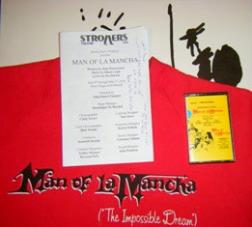
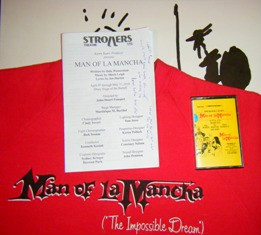
I have kind of a “history” with Man of La Mancha, produced by Strollers Theatre at the Bartell this week and next, so I’ll be using a lengthier introduction than I normally do. If you want to skip to the part where I talk about the play, click here.
In my hometown of River Falls there’s a semi-professional troupe called Saint Croix Valley Summer Theater. I don’t know when I first started going to their plays but I believe my fondness for the theater has much of its origin with them. A SCVST production was my introduction to Man of La Mancha. I don’t remember the year and so don’t know what age I would have been, but I probably wasn’t older than 15. I do remember the actor who played Cervantes/Don Quixote, a dashing chap named Troy Dunn who had prominent roles in other SCVST shows, including The Mousetrap, Barnum, and Deadwood Dick, or a Game of Gold.
I had some basic familiarity with Don Quixote, because I had heard a radio adaptation around that time, so I knew the concept would be entertaining at least. What I experienced, however, was something that had more emotional resonance than any other play I had seen. The music and lyrics were adventurous (“For a holy endeavor is now to begin / And virtue shall triumph at last!”), searing (“You have shown me the sky / But what good is the sky / To a creature who'll never / Do better than crawl?”) and inspiring (“To fight for the right / Without question or pause / To be willing to march into hell / For a heavenly cause”) [I was tearing up just typing these lyrics.] It was among the first plays to show me the kind of audience connection that only a live stage production can make, and that there are some things that can exist only in the theater.
The plot devised by Wisconsin-born writer Dale Wasserman has humor, tension between idealism and cynicism, a brutal retaliation against a character who follows the “demands” of nobility, a knight created and later shattered by imagination combined with self-perception, and ultimately hope. But the masterstroke that keeps the show from being simply a “musical Don Quixote,” to use the forgivably economical description in the print version of Isthmus’ Guide, is the frame: Imprisoned by the Inquisition, Cervantes tells the story of Don Quixote to his fellow prisoners, who take part in the story themselves. In this way Man of La Mancha also becomes a tale about storytelling and theater itself, and its ability to uplift and transform.
I felt quite an affinity for this representation of Don Quixote, and Man of La Mancha is one of two orginal cast recordings I’ve ever owned (the other is The Phantom of the Opera). Not counting the Quantum Leap episode, the next Man of La Mancha I saw a touring production at the Madison Civic Center. I don’t remember the year apparently it was 2001.
I still saw myself as a sort of quixotic figure — having been an only occasionally drinking UW-Madison undergraduate with comparatively esoteric interests like silent movies, old-time radio programs, and writing short plays contributed to that — and musical theater’s Dulcinea/Christine Daaé model of the transformative romantic desideratum [because I don’t wish to write a paragraph explaining what I mean and don’t mean by romantic “object”] had some appeal for me at the time. This production wasn’t the transformative experience that the first one was but I remember a few things: The line “Facts are the enemy of truth” getting applause, Don Quixote’s corkscrewed sword, couple of moments of forced humor, an “iris out” on the Padre singing “To Each His Dulcinea”.
So, yeah, high expectations going into the Strollers production. My own perspective has changed: I’m now more like the prisoners needing convincing than I am a Knight of the Woeful Countenance. My personal experience has been that quixotic nobility doesn’t receive meaningful validation outside the theater, and the appeal of virtue for its own sake is wearing off a little. Regarding Dulcinea, I wasn’t holding out for perfection but still, like the song says, “the man with moonbeams in his hand has nothing there at all.”
So, on to the Strollers production.
I saw the opening weekend’s Saturday matinee performance, so I could have a row to myself and avoid detection if I started getting weepy (which I did). I also kind of jumped the gun in going up to the theater before the house was open – my apologies to stage manager Martinique M. Barthel.
I’ve seen lead actor Donavon Armbruster in other performances and knew that he had a vocal quality that proved to be an excellent fit for Don Quixote: Nobility with an undercurrent of pathos. This was especially effective in the song in which he professes his dedication to his imagined lady, “Dulcinea,” and in the vigil that includes Don Quixote’s recitation of knightly ideals (“love not what thou art, but only what thou may become”) and the show’s signature song, “The Impossible Dream.”
Dulcinea / Aldonza is the other key character in the show, the one who changes over the course of the story, and Leah Isabel Tirado portrayed strength and yearning in a potent acting and vocal performance. I thought I knew what to expect from Sancho Panza — a high-pitched comical singing voice and goofy devotion — but predictability and Pete Rydberg don’t really go together and I was surprised and amused by Rydberg’s dignified, ceremonious signing of the missive Don Quixote writes to Dulcinea.
I was aware that Man of La Mancha had a fight scene with muleteers but it isn’t known for that the same way that, say, Phantom is known for having a chandelier. Yet in this production, fight choreographer Rick Stemm created an impressive sequence that involved Sancho and Aldonza serving as Don Quixote’s proxies without him realizing it, seamless transitions to each subsequent set of combatants, and adroit use of a ladder.
The costumes, designed by Sydney Krieger and Hyewon Park, worked well with the “improvised” conceit of the play, and the appearance of Don Quixote’s wraithlike final adversary and his fellows was a dramatic visual. Don Quixote demands that the enemy knight identify himself and the knight initially refuses to do so. While I question whether a knight facing you with an uncovered, mirrored shield would feel the need to defer identifying himself as the Knight of the Mirrors until a more opportune time, his accoutrements made up for that quibble. The mirrors’ design provides an interesting way to communicate the violence of the intrusion of hyperrealism into Don Quixote’s self-perception and to suggest that this type of worldview is as flawed as an excessively fantastical one.
Director John-Stuart Fauquet — who was music director for Mercury’s production of The Full Monty, one of my favorite shows of 2008 — has created a trim, brisk production. Running time is about 100 minutes, there’s no overture or intermission, and it stays close to the premise that what you’re seeing is an impromptu performance of Don Quixote in an unexpected location. The set designed by Courtney Nelson ably represents the cold stone of a prison common room and this representation is further assisted by the blocking: there’s a “backstage” behind a trio of arches but characters exit the stage only through the door in the upper level.
There are some cuts to the script. One was minor, removing a brief song near the end in which Sancho shares “gossip” with the defeated Don Quixote (“I haven’t fought a windmill in a fortnight”). More significant was the scene in which the muleteers retaliate against Aldonza after their defeat in the fight sequence. In the productions I’ve seen they taunt her with a song played earlier and there’s a scene break after they incapacitate her. But in this production the play within the play was interrupted by the Inquisitor, so the audience doesn’t have as much time to imagine what happens to her next and it wasn’t easy to disassociate that interruption with what happened to Aldonza in the context of Cervantes’ story.
There’s also an addition to the script: The prisoner who will portray Aldonza begins the play with a song, creating symmetry with the end of the play, where she is the first to sing as Cervantes leaves the prison. I don’t know Spanish and caught only the word “fuego,” so I can’t fully assess the cleverness of this innovation.
The music is provided by a guitar, bass, keyboard, and percussion. I kind of missed hearing flute and brass during Don Quixote’s first song, in which he “hurls down his gauntlet” to a “bleak and unbearable world,” but a smaller orchestra is consistent with the theme of engaging one’s imagination. There were elements of the vocal performances that weren’t up to, say, a Four Seasons Theatre standard but overall, Strollers’ production does right by the script and I was essentially happy with it.
So, will quixotic figures be validated in what, for simplicity’s sake, I’ll call the “real” world? Will the impossible dream be attained?
Of course not. That’s why theater’s magic.
But God help me, I’m still a man of La Mancha.
Man of La Mancha is at The Bartell Thursdays at 7:30, Fridays at 8 p.m., and Saturdays at 4 p.m. and 8 p.m. until May 1. Tickets are $15.