



[b][i]Police, Adjective[/i] plays again Sunday at 7:30 at the Madison Museum of Contemporary Art.[/b]
I'd heard about [i]Police, Adjective[/i] before it came to the WI Film Fest this year, and I was excited at the chance to see it on the big screen. As I'd read, it was a scathing criticism of the bureaucracy that lingers in post-Soviet Romania and a compelling story of a police officer fighting not to compromise his conscience. The pace, sadly, was so painfully slow that I considered leaving early.
The protagonist is Cristi, a police officer who has been assigned to follow a high school student suspected of dealing pot. He's certainly smoking it, but Cristi cannot find any evidence of more than that. His boss wants the arrest, but Cristi doesn't see the harm being done and doesn't want to live with the consequences of ruining a teenager's life.
At the same time, Cristi wrestles with a system so mired in red tape that it's hard for him to do his job. Tasks that would be trivial in the US -- or at least in an American police procedural -- require cajoling and personal favors in Cristi's station. "That's not my job" and "you aren't my boss" are the watchwords of his co-workers. It comes as something of a surprise that Cristi's captain cares so strongly about making an arrest.
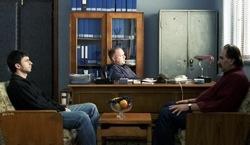
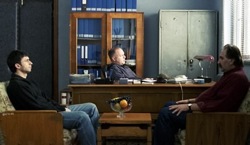
Much has been written about a scene late in the movie between Cristi and the captain. They argue about conscience versus law, the captain forcing Cristi to hunt through a dictionary for a definition of "moral law." They're unable to find it. The scene is very good, as are many in the movie. Cristi is a believable character and his position is one that challenges the viewer. What would you do if it were your job to uphold the law but you believed that law to be unjust?
The key failure of the film is the pacing of several scenes where Cristi is staking out the subjects of his investigation. What he's doing is itself quite boring, and I appreciate the filmmakers' desire to convey that to the audience. But scene after scene of several minutes worth of a man pacing around outside a house is too much. Worst of all, these scenes leave the audience so exhausted that two key scenes that should be tense -- one waiting outside the boss's office, one waiting in it -- are instead more drudgery.
Some movies really benefit from being on the big screen. They're more exciting, bigger than life, and just aren't the same if you watch them at home. Even if it didn't suffer from such critical pacing flaws, [i]Police, Adjective[/i] would be a fine movie to rent and watch at home. As it is, watching it at home would likely be a superior experience since you would have the chance to fast forward or at least get up and get some popcorn while Cristi and you wait for something to happen.