



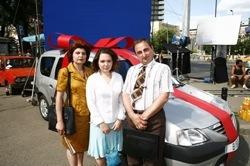

[i][b]The Happiest Girl in the World[/i] plays again Thursday at 5:00 p.m. at MMoCA.[/b]
On the surface [i]the Happiest Girl in the World[/i] seems to pose the question of how much responsibility children have to make sacrifices for themselves and for their parents. Delia wants to keep the car she won in a contest; her parents need to sell the money they can get selling it. While Delia's parents talk about her and their future and how much better it will be, she merely protests that she wants the car and that it is unfair that she can't have it. To each, his or her point of view is obvious and the other's irrelevant.
The characters in [i]Happiest Girl[/i] don't actually disagree with one another. When they argue, it isn't that they want opposite things, it's that they aren't arguing about the same thing. Part of the deal to get the car is that Delia must star in a commercial where she declares herself to be the "luckiest, happiest girl in the world." She doesn't sound convinced, and the crew filming the commercial doesn't understand why she's so glum. The director wants to produce something of artistic merit. An executive from the company buying the commercial wants Delia to look happier so his product looks good. The crew just wants to get the job done before the sun goes down so they don't have to come back tomorrow. Delia's parents want financial stability. Delia wants to keep the car.
All these characters are frustrated by what they feel are attempts to stymie them. The real tragedy of the film is not that Delia is forced to feign excitement about winning a car she can't have. It's that no one involved stops to try to understand one another's point of view. This is an honest film. This sort of conflict is what happens between people in the real world. Delia's parents aren't forcing her to give up the car out of spite, and she doesn't want her family to remain poor. They, like all too many people, are so focused on their own wants and needs that they cannot understand the wants and needs of those around them.
The flaw of [i]Happiest Girl[/i] is that, as interesting as the premise and concept are, the characters themselves aren't easy enough to identify with. The executive and film crew are too one dimensional. Delia's refrain that she wants the car even though she cannot defeat her father's logic is frustrating. Her parents' are, logically, right but come off as somewhat cruel. As effective as the film is at illustrating the frustration of several people's lack of understanding of one another, it ultimately doesn't have the drive to elevate it from interesting to entertaining and memorable.