



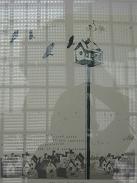
 View originalReview of a group print exchange show at Memorial Union
Image is of “Then I’ll Be Smiling” by artist unknown
UW Madison’s Memorial Union is home to a large collection of rotating prints of all kinds and contents. On your way out from getting ice cream at Babcock stand or in to buy beer and sit on the terrace, you can pass a cool or warm hour or two lollygagging up the dark stairs, down side corridors, and find provocative, peaceful, many-patterned lithographs, seriographs and linoleum prints, and more. It’s a treasure, spread wide across the long building, and free. It’s the Union’s permanent collection.
For the rest of August and all of September, there’s a special print exchange on exhibit, which is not part of the Union’s permanent collection. On the second floor, starting along the Frederic March theater, and then down the steps on the lake side of the waiting area for the Wisconsin Union Theater, overlooking the terrace, dozens of prints with the loose theme of “Home Sweet Home” create a journey of houses, childhoods, loss and belonging.
The UW Art Department commissioned this exchange from professors at home and others related to the university further away. Unfortunately, though a long list of all the invitees is posted downstairs, quite a few of the pieces are not only lacking titles (forgivable) but signatures – or if there is a signature, it is illegible, and there are no labels. It’s a shame because I’d love to give credit to a lot of these inventions where credit is due.
I have to mention another loss – that of the light reflecting off the lake and terrace all over the glass encasing the show on the first floor, circling around the Wisconsin Union Theater. As we started upstairs at the Frederic March theater, we were already engaged and thrilled to find more downstairs. However, most were not photographable and quite a few were not even visible in midday sun.
Despite these drawbacks, the quality and diversity of the art is amazing in this exhibit. One untitled, un-credited piece shows a girl wrapped in rope, lying on the ground, the weight of her holding up a house in the background, the rope connecting them by way of a pulley up top. The girl is comfortable with her burden, asleep, her hair tangled in the bed of excess rope. But the message of ambivalence towards home is strong.
Of other interpretations that are strongly symbolic and on the more literal side, there is another unnamed, un-attributed photographic print, a sepia image pulled straight from the frames of Coraline. The sight is one of tilt-shifted-esque multi-layered mini houses, a kind of neighborhood balancing the comfort and closeness of home with some of its claustrophobia.
Certainly not all the prints involve houses. Julia Taylor’s unnamed print, a mesh of organic shapes – holes and eggs and strands – is a beautiful exploration of some of the very same senses and perceptions in the two pieces I just named, and yet, it also stands on its own as a lovely organic piece.
An unnamed and untitled print on the lower level uses many levels and layers of block print faces to establish a composite – a sort of face made out of faces – which carries the symbols of both Russian stacked dolls and the people who make up who we are – and what our sense of home is.
Another artist, Emmy Lingscheit, uses a sliced open heart depiction to reveal a different melee of the many people who make up our home. Trapezes and teddy bears, boys on beds and kids sliding down steps on a rug and more make for a circus atmosphere which borders on impossible with a side of great delight.
The piece one which caught me most on the day I saw the show is called “Then I’ll Be Smiling,” again, by an unknown artist. It suits the graffiti lover in me, with its spare black and white style, and a tiny amount of typed words. The words themselves drove home for me this struggle between our childhood homes, other homes we’ve had between, and finding home in oneself. The text reads:
Embarrassed looks and tired words
They burrowed deeper into the ignorant
Little lives they preferred.
Then they ask if I’m good enough…
The print shows a birdhouse-like house steeped high above all the others, the words falling in the space along the pole. Above all, this text captured the poignancy of this tricky idea of home, much less whether or not it is “Sweet.”