



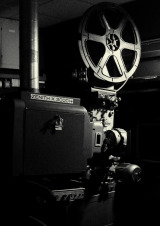
 View originalNew York, Los Angeles and Madison. There was a time when those three cities were the centers of U.S. film culture, if you agree that such a claim can be best measured by the number of different movies shown. An often forgotten component of campus culture during the Vietnam era, Madison was abuzz in those pre-VCR days with movie screenings, including and especially foreign films and older movies, with audiences to match. I can't quite picture what it must have been like, but imagine if the film fest never ended. (In its early years the Wisconsin Film Fest payed homage to this era with their "Bergman's Show" program.) And part of that moviegoing experience certainly would have been the wildness and woolliness of actually trying to project light through celluloid onto a screen before an eager audience in unconventional places like classrooms and dorms. None of it would have passed THX muster, I'm sure, but it got the job done and pleased the crowds. Checking out three Thursday screenings at the Wisconsin Film Fest put me in mind of this time.
I witnessed three different kinds of projection Thursday night -- traditional 35mm at the Madison Museum of Contemporary Art, HD video projection at the Wisconsin Union Theater and standard definition video projection at the Chazen Museum of Art, three auditoria whose main use is not showing movies. (The fact that the whole downtown turns into a treasure trove of movie venues is one of the festival's blessings.) The projection at MMOCA was just fine -- the movie, Jerichow, had white-on-black titles in a serif font and you could definitely see the image shake a little, as a machine is wont to do if you make it spin a hundred pounds of film around in a circle. As the movie went on, however, the image never seemed anything other than solid or stable, at least to the standard that moviegoers have come to expect. The screen was well-lit by the projector, focus was sharp, colors were strong, and it felt like going to the movies. At the Wisconsin Union Theater, I stopped in to watch a few minutes of Earth Days, a documentary with original footage shot in DV intercut with clips from various provenances, digitally projected with an HD projector rented especially for the festival. Now, the Wisconsin Union Theater has 35mm equipment, and the 35mm movies I've seen there, like 2001 and Mulholland Drive, have been adequate -- if memory serves, the image quality was good enough but the sound left something to be desired. But Thursday night, in this big room where the projector has got to throw quite a distance, the HD looked very sharp indeed when showing original DV footage, with deep inky blacks, reasonably high contrast, popping colors (the screen seemed to luminesce) and absolute rock stability. When the wind blew through the trees in the background, you could see that the camera/projector was pushed past its limits, with that fine distant motion devolving into pixelation, but for the most part there were no obvious flaws. (The archival footage intercut into the movie didn't fare as well, but those are hard things to judge for a variety of reasons.) Did it still feel more like watching television than watching a movie? That's a hard call to make, because Earth Days is in fact a PBS documentary, but it kind of did in a too-perfect way -- we're not used to watching a movie that bright and that stable, plus of course there's no film grain or emulsion, although as film processing has improved over the years you see less and less of that in filmed entertainment. All in all, an impressive performance from this equipment, even if it felt categorically different than film projection. Watching a standard-definition video remaster of a 35mm source at the Chazen, however, is probably not something I'll ever do again ... at least not with the expectation that I am Going to the Movies. I hadn't previously seen Tokyo Sonata in 35mm but I've seen the director's other work and he's technically fastidious, so I have no doubt that the actual image quality is unimpeachable. At the Chazen, the picture was big and stable and looked like I was watching a high-quality VHS tape. I assume the projector was a step up from your average classroom data projector, and while the pixelated nature of the image didn't jump out at you, the blacks were bruise purple, the subtitles were gruesomely anti-aliased and a nighttime beach scene was covered in a scrim of static. When the scene was well-lit and largely stationary, which was most of the time, the projection was OK, but it was always with the fuzziness of video, never the clarion purity of a photograph. But my grumbling is stopped short by three things. One, my appreciation for what the festival is, with all the budgeting, scheduling and tooth-pulling it entails -- it can't all be 35mm, so something's got to give, although maybe the success of the HD trial will justify the proliferation of better video equipment all around next year. Two, my imaginings of what that non-stop film festival of the '60s must have been like -- just as imperfect, by necessity. Which leads me to three, my sincere desire to be the kind of movie lover who, when presented the choice of seeing a movie in hermetic perfection by myself on my couch or in dubious condition with a crowd in the movie's natural habitat of a theater, will remember that movies are always best when there's an audience you can commune with.