



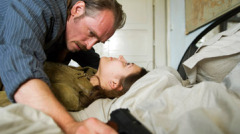
 View originalThe Austrian thriller Revanche (Revenge) was my favorite contemporary movie of the festival in a walk. It was nominated last year for the Best Foreign Film Oscar, so I'm not the first to sing its praises, but it moved me to song nevertheless. There's nothing that's specifically a spoiler in what follows -- at most, I will tell you what the movie doesn't do -- but all the same my heartiest recommendation would be that you just Netflix it (and/or hope for a 2009 American theatrical release) without knowing anything more about it other than that it is as good as a movie with a handgun can be. If you need more of a nudge than that ... well, everyone knows the most famous saying about the titular subject, "an eye for an eye," as well as its bumper-sticker addendum supposedly coined by Gandhi, "... leaves the whole world blind." Revanche is a revenge movie where the characters end the movie seeing more clearly, and that's more of an accomplishment than it might first seem.
Tamara (Irina Potapenko) wants to get away from her Viennese brothel; ex-con Alex (Johannes Krisch) wants to help her by way of robbing a bank in the small village where his grandfather (Johannes Thanheiser) keeps a farm, and the farm's nearest neighbor is the rural home of policeman Robert (Andreas Lust) and his wife (Ursula Strauss). That's all the plot synopsis you're going to get; now please allow me to wax narratological. Plot and character are essentially the same thing. How do you make a plot? Devise a series of story events that reveal the nature of the person to whom they happen. How do you make a character? Determine what kind of person would have the most interesting response to those story events. If you want your character to be a certain way, you have to change your plot to match, and vice versa. A corollary of this axiom is that if you want a vivid character, you need a vivid plot to really put the screws to that character, and if you follow that idea to its natural conclusion you get Greek tragedy: Who is the worst possible person for Oedipus to marry? What is the worst possible promise he could make about punishing whomever has offended the gods? (The last scenes of Watchmen would be a good recent example of this phenomenon.) A related concept in storytelling is known as Chekhov's gun, which is based on the playwright's admonition that if you have a gun prominently placed on the mantle in the first act, that gun has to be fired in the third act. It's both a matter of good story construction, as well as fulfilling a promise subliminally made to the audience. Revanche is a perfectly plotted affair and makes a dozen good uses of this principle that may be too subtle to catch on first viewing, but the big one, the gun-sized one, is the circular saw Alex uses to chop wood on his grandfather's farm. It makes you apprehensive every time it's onscreen; it's the perfect implement for bloody revenge. But nothing dramatic happens with the saw, which I think is a coded message from writer/director Götz Spielmann that he is likewise not going to carry Revanche to its "natural," Greek-tragic conclusion. Most stories grow from one good idea, and my guess is that Spielmann's kernel for Revanche is the offer someone makes Alex around the movie's halfway point, a development that elevates the movie from good to compelling. This is a great kernel, and one that could easily lead to of the cataclysmic, Titus Andronicus ending promised by the title. All the pieces are on the chessboard, and you can feel the dread accumulating every minute that the movie goes on. ... But I don't want to spoil the ending. Suffice it to say that the ending is perfect, truer to the rhythms of life than the heightened tempo of drama, and the emotion that ensues delivers that dearly sought after closing-credits high. (The applause at that Orpheum Stage Door screening was, to my ear, the most enthusiastic I heard at the fest.) I haven't said anything about the performances, which are unbesmirchable, or about Spielmann's technical acumen, because the whole movie is basically an unending sequence of beautiful shots. There's a scene near the end where the wind blows across the surface of a pond. I don't know if Spielmann had fans hidden in the trees, or if he just shot the scene enough times to get one take where the wind blows at the right moment, or if, eerily enough, it just happened. But the effect is unutterably sublime, selling the movie's theme all by itself. Revanche is a corker.