



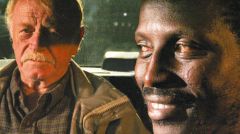
 View originalI missed the Oscar-nominated Happy-Go-Lucky last year, about a woman whose response to the travails of the world around her was undefatigable cheeriness. But in the same vein there's Goodbye Solo, whose main character, Solo, is a Senegalese cabbie in Raliegh whose optimism and charm just won't stop. In the movie's first 10 seconds, it lays out its premise: William, a retiree, wants Solo to drive him to the top of a mountain in a few weeks' time -- a one-way fare. Solo doesn't get it, asking what is he going to do with a one-way fare to the mountains, jump? And then, realizing that's the case, Solo determines to pull William back from the brink with friendship. This is writer/director Ramin Bahrani's fourth feature film, and his third consecutive WFF appearance; in those movies he tells an immigrant's story using nonprofessional actors, and his success in that vein has established himself as a significant new talent. Indeed, those are the two facets that are most interesting about Goodbye Solo -- Souleymane Sy Savane's performance, and his character's perspective on William's situation. Solo is in this country so he can send money back to his African family, and his retirement plan is to return home while the next generation goes off to make their fortune and sends their money home. William's circumstance of being utterly without family or recourse is as alien to Solo as Solo's subsequent hospitality-and-then-some is to William.
This tension is enough to drive the rest of the movie, and both characters do come to learn something about the other's perspective, but as you might expect this is no Rob Reiner movie. Solo is both self-aware and loquacious, so audiences can feel reasonably comfortable with their handle on him, but William is both terse and unreliable, and the peeks we get into his head aren't enough to show us why his despair is so impenetrable. I'll grant that this opacity may be part of Bahrani's conceit -- that William's family-stunted closed-offedness is to be taken as a given in the same way that we don't question Solo's lust for life -- but irresistible force vs. immovable object doesn't strike me as a viable premise for a story told with as much tenderness as Goodbye Solo. The critical moment of the story is when Solo chooses not to discuss William's case with a particular third party whose involvement could turn the tide, and I don't know quite why Solo demurs. It would be an act of almost unthinkable buttinskyism, but at the same time his belief that William's life is at stake is absolute. It's not that Solo cannot or should not resign himself to William's fatalism, but the fact that he does so is significant, the culmination of a certain loss of innocence he suffers over the course of the film, and yet it is also not explicable as merely that.
Apart from this, the movie is smartly constructed on a scene-by-scene basis -- much of it is way over yonder in a minor key, but dramatically effective all the same. The two lead performances are critical -- Savane is terrific in as Solo, his face an open book that befits the character's unabashedness, and Red West is pretty devastating as William, who carries enough self-possession that you understand both the sorrow and the dignity he feels in his own abnegation. West is a professional actor, but mostly in small parts; here he's a galvanizing screen presence. Bahrani shoots the movie beautifully, particularly its last scenes in the Great Smoky Mountains, but also as the character navigate some of Raliegh's low-rent byways. The crowd at the Orpheum Stage Door tended older than most fest screenings I've attended over the years, but it was a packed, appreciative house.