



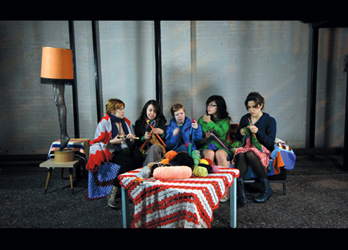
 View originalGrowing up, I was inundated with the craftier side of life by a mother who loved all things make-it-yourself. She was an avid rubber stamp collector and greeting card making, and a school teacher who decorated her classrooms with all manner of homemade embellishments. From her I learned how to bake paper-thin Christmas cookies, emboss gold or silver powder into a holiday card, and to draw.
All these years later, I’ve stopped making a point to do quite so much of my own crafting. And, quite frankly, I miss it. So it has been with considerable delight that I’ve discovered the indie craft movement that’s burgeoned in the US over the past few years. Faythe Levine, a Milwaukee-based artist, recently set out to document this resurgent cultural phenomenon with her movie, “Handmade Nation,” which I was fortunate enough to catch on Friday night at the Play Circle Theatre. I was also fortunate enough to catch Levine for a brief email interview about the movie, which was posted here a short while ago (and can be read by clicking this link).
Meg Hamel, the director of the Wisconsin Film Festival, personally introduced the film and pointed out that she herself was a longtime knitter. “When I was about 13, my first project was to make an argyle sweater.” The crowd gasped and laughed. “Yeah, much like this festival, I pretty much don’t tackle projects unless they’re really, really hard.”
The film isn’t terribly long—it clocks in at just 60 minutes—but it doesn’t feel too short or too long. It profiles a wide range of artists from around the country, including people who’ve opened retail shops that primarily sell DIY projects from area makers. It shows the surprising number of indie craft fairs that have sprung up in many states, and how the genesis of the modern movement goes back to the punk DIY ethos.
Jenny Hart, for instance, is the proprietor of Sublime Stitching and creates works of impressive embroidery with decidedly modern subjects like Iggy Pop and Marianne Faithful. “I thought embroidery would be this tedious thing, but once I started I realized that it was better than drugs or alcohol or anything like that,” she noted. This elicited a good chuckle from the viewing crowd, which it was easy to tell was primarily made up of crafty type folk of all ages and genders. There’s Knitta, a group of guerilla knitters who affix brightly-colored cozies to light poles and traffic signs around their city as a sort of fabric graffiti; The Little Friends of Printmaking, a Milwaukee duo of screen printing artists who make posters and toys; The Dirt Palace in Providence, Rhode Island, a mixed used “feminist art collective” space that houses everything from fabric work to painting to printing. Overall, the movie is fun, informative, and quite enjoyable. Some of the camerawork is a little rough, darting around to catch as much of the piles of artwork behind the interview subjects as possible without really settling to focus. The sound is occasionally muddy. But these are its only real flaws, and you could make the argument that the film itself is fairly DIY, too, fitting right in with the overall theme. In fact, the soundtrack music itself is provided by the director’s own band, Wooden Robot, and is great fun (I always appreciate good use of theramin, personally). Regardless of your level of interest in handmade crafts, I would recommend checking out this film. It provides an interesting glimpse inside a modern movement with deep roots, focuses on a productive rebellion against consumer and mass-produced culture, and provides a lot of inspiration for the incorporation of a more self-reliant ethic into your own life. After all, as both Levine and Hamel have pointed out, all craft is DIY. “Handmade Nation” is playing again tonight (Saturday) at 8:45pm, at the Play Circle Theatre in the Memorial Union. (photo courtesy/by Princeton Architectural Press, 2008)