



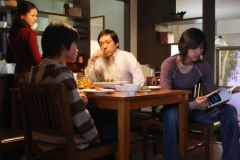
 View originalI was first introduced to Kiyoshi "No Relation" Kurosawa at WFF2004 when they showed Cure, which is to J-horror what David Lynch is to John Carpenter. Like Lynch, Kurosawa is an exquisite craftsman of both sight and sound in the service of mysterioso dread, and he's unafraid to leave you hanging. But he steps away from genre -- and into the most laurels of his career -- with his most recent film, Tokyo Sonata. When Ryûhei Sasaki (Teruyuki Kagawa) loses his white-collar job, he keeps the secret from his wife Megumi (Kyôko Koizumi) and sons Takashi (Yû Koyanagi) and Kenji (Inowaki Kai), leaving for work everyday but spending that time in unemployment lines and at soup kitchens. Professional jobs are few and Ryûhei's not ready to give up that particular part of his self-image, so he leads this double life with all intentions of maintaining it for as many months as his unemployment insurance keeps coming. Not that he's king of a very successful castle -- he tries to browbeat preteen Kenji out of his interest in music; he curses teenage Takashi's shiftlessness and, later, his decision to volunteer for the American army; and he fails to provide any kind of emotional succor for Megumi, a housewife type familiar from many modern American mellers. For a minute this seems like this is going to be Kurosawa's take on Time Out, a great modern movie that's also a dread-heavy exploration of upper-middle-class unemployment in which you're always worried things are about to tip into violence. Instead, Tokyo Sonata turns out to be nearest to American Beauty, but with a cultural critique that seems quite specific to its time and place.
The movie opens with Ryûhei's boss being sold on the efficacy of outsourcing jobs to China, and in the next scene when he asks Ryûhei to describe the skills that qualify him to keep his job, Ryûhei has nothing to say. This reoccurs throughout the movie -- Ryûhei clings to this idea of himself as professional because in his years in "administration," but cannot express a scintilla of any expertise or passion. Even at the height of his unemployed desperation, having gotten his foot in the door for an interview, he is utterly unprepared for even the most basic questions about his abilities; a puzzled Ryûhei asks if the interviewer means, like, singing karaoke? Likewise, Megumi can't express why she remains in her marriage. Tokyo Sonata's grown-ups are robotically engaged in a fruitless adulthood, and so provide no moral instruction to their children beyond clichés and platitudes. Takashi volunteers with the US Army because he wants to be a peacekeeper, to which his father can only retort that the state of the world is not an individual's concern. Kenji and his friends are regarded as preternaturally wise for realizing that all the adults they know are imbeciles, but Kenji clearly also aches with the knowledge that it should not be this way. So far, so good, but also "so what?" -- we've seen this story before, and while Kurosawa is clearly articulating a particular concern about the Japanese middle class losing their souls to anonymous "professional" labor so unengaging it literally defies description, it's not an especially convicting portrayal.
Then, a little more than an hour in, we watch Kurosawa reestablish his kinship to Lynch through a series of scenes that, Twin Peaks-like, disturb the domestic tableaux -- Megumi (who turns out to be as much the protagonist as Ryûhei, if not more so) finds something unexpected under the stairs; Ryûhei finds an envelope full of cash that weighs upon him; Kenji helps a runaway classmate evade the parents he's sure will beat him, much like Kenji himself was concussed by an enraged Ryûhei; Takashi returns home haunted by all those he has killed. From here the movie spins off into kidnappings and flashbacks and dream sequences and hallucinations and reckless sex and medical emergencies and grievous bodily harm ... only to resolve in a way that skirts triteness simply by being beautiful. (Albeit genuinely beautiful, not plastic-bag beautiful.) Tokyo Sonata doesn't strike me as a masterpiece, but Kurosawa is undoubtedly an auteur worth watching, and there's plenty to get out of his take on domestic melodrama, complete with his standard gorgeous frames and perfectly measured performances. The audience at the Chazen was rapt, stirred especially by the movie's depictions of violence against children.