



 View originalIt was a cold and drizzly way to start the 2009 Wisconsin Film Festival, but the weather hardly seemed to deter dedicated movie goers as they lined up for and piled into the many films showing on Thursday night. I headed down to one of the later shows to kick off my fest experience, opting for a screening of the documentary, “Earth Days,” which played at the Wisconsin Union Theatre to a relatively full house.
I ended up spotting and sitting next to fellow writer and 77Square reporter Katjusa Cisar, as we both (somewhat shame-facedly) worked to send out Twitter updates and jot down notes about the movie. You’re likely to see her own take on it later today.
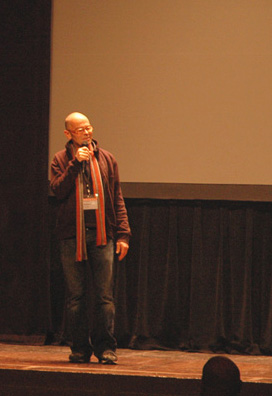
As for me? I enjoyed the film, though I thought it lacked some of the clear focus and direction that becomes so necessary when trying to pack a great deal of history into a 100 minute story. But it is a fantastic work of no small amount of import. Director Robert Stone, a UW-Madison graduate and now award-winning documentarian, was on-hand to take a few questions after the screening and said that he did intend for this to be part one of a two part series (he’s currently working to find funding for the second half). There is, indeed, a lot to pack in here, as “Earth Days” strives to cover the history of the modern environmental movement in America.
The movie begins by introducing us to its 9 central figures—people who were instrumental to getting the early movement off the ground in the 1950s, 60s and 70s. It was a smart move, focusing and grounding the story in these more personal narratives, as any historical piece runs the risk of becoming mired in its own epic scale. But Stone chose well. There’s Stewart Udall, who served as Secretary of the Interior from 1961 to 1969 and was a driving force behind many of the country’s earliest environmental laws (the Clean Air Act, the Wilderness Act, and the Endangered Species Act, to name a few); Stewart Brand, a futurist and founder of the Whole Earth Catalog; Dennis Meadows, co-author of the groundbreaking book, Limits to Growth]; Hunter Lovins, co-founder of the Rocky Mountain Institute, among many other things; Paul Ehrlich, author of The Population Bomb; Denis Hayes, coordinator of the first Earth Day; Stephanie Mills, author and environmental activist; Rusty Schweikart, an astronaut and co-founder of a group that aims to prevent deadly asteroid impacts with the Earth. “Earth Days” covers a lot of ground, starting with the earliest days of what we now call the environmental movement, the publishing of Rachel Carson’s groundbreaking book, Silent Spring, which dealt with the overuse of pesticides and other chemicals, and moving all the way through to when Ronald Reagan took office and began to roll back much of the progress that had been made. In the movie, Lovins commented about the era that followed, saying that, “We lost 30 years because both sides have ossified their ideologies.” It’s not all doom and gloom, though. The movie charts the course of the very first Earth Day in 1970, which ended up being the largest single demonstration in US history, with over 20 million people nationwide participating. The movie draws on a mound of historical footage, including a lot of great shots of that first Earth Day event. We see crowds of people wearing gas masks and carrying signs, stomping on great piles of aluminum cans, and bashing in cars with sledgehammers. Interspersed with the archival pieces are some really spectacular overhead shots of some of our country’s more breathtaking features: The Grand Canyon, meadows at the feet of mountains, the Everglades, but then also the long ribbons of light and asphalt that make up our cities, pollution hazing over horizons, and endless seas of suburban sprawl. The message is clear, and the personal stories of struggle, awakening and triumph told by the movie’s various narrators are all moving and effective. Where “Earth Day” suffers, though, is in its focus, as it attempts to pack in as much information and history as possible. “It was kind of like making a movie about everything,” Stone commented during the Q&A that followed. And it does begin to feel more like a PBS educational piece than a big-screen doc. But then, Stone indicated that it was to be shown on that very channel come summer, and was shot with a television audience in mind. He went on to stress what he felt were some of the important lessons learned by the early movement, and how the modern activists could draw upon those experiences to improve their methods now. Stone emphasized the importance of reaching out to more than just the traditionally middle-class base that made up the majority of the movement for so long. “One of the very serious problems we deal with in making the environmental movement a global movement, is that when someone is worried about where their next meal is coming from and how to care for their children, the environment becomes a little hard to focus on for them,” Stone said. He also pointed out the frustrating fact that “The messenger is as important as the message, sometimes,” indicating that he felt “Carter said all the right things but he was a terrible salesman. Now we have someone in the White House who’s a terrific salesman, so I’m hopeful that we can really make some progress.” The screening had its fair share of uniquely Madison/Wisconsin moments, too, as the audience broke into sporadic applause when hometown heroes like Gov. Gaylord Nelson were mentioned. Then, when figures like George W. Bush and Ronald Reagan appeared, there was no small amount of booing and rueful laughter. A rip-roarin’ adventure “Earth Days” is not, but then, that’s not what it sets out to be. While I wouldn’t recommend this as a particularly theatre-friendly movie, it’s definitely a worthwhile film for television, the classroom, or a related conference. Stone does an admirable job of relating the story of what is arguably one of the more important movements to come out of the 20th century. And it’s not an issue that’s likely to go away any time soon, somewhat unfortunately insuring the movie’s continued relevance for a long time to come.