



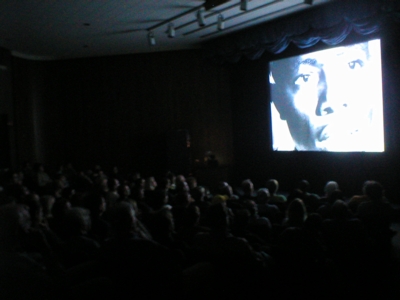
 View originalThe World Premiere of Henry Aaron's Summer Up North, a feature-length documentary by Joshua Adams and William Povletich was screened this morning at 11 am as part of the Wisconsin Film Festival. The doc is about Henry "Hank" Aaron and his first experiences with playing within the Major League Baseball system, as a shortshop in the summer of 1952 for the Eau Claire Bears. The Bears were a Class C farm team playing in the Northern League (alongside teams like the Duluth Dukes and St. Paul Saints) that were part of the farm system for the Boston Braves, destined to move the following year to Milwaukee.
The film opened with a look at his childhood and teen years growing up in Toulmanville, just outside of Mobile, Alabama. With the South still ruled by Jim Crow in the Thirties and Forties, Aaron grew up in an environment of segregation, which affected the trajectory of his career in baseball.
Though the color barrier in baseball was broken by Jackie Robinson in 1947, the Negro Leagues remained for at least a few more years the primary means for black baseball players to get their start at the professional level. Aaron was the last Negro League player to take this path to the major leagues. After playing semi-pro ball in high school, he was signed by the Indianapolis Clowns, and after a short amount of time playing with that team, his contract was sold to the Major League Boston Braves franchise. The Braves sent him to play with the Eau Claire Bears in the summer of 1952, and this was to provide Aaron's first life experiences outside of a segregated setting.
As described in the film's festival promo, the "film documents how Aaron made headlines in the Eau Claire sports pages while he dealt with adjusting to Northern culture, which was at turns welcoming and full of racism and ethnic ignorance." This issue of race and the specific experiences of Aaron, as a young African-American man from a segregated Southern city coming to a monochrome Northern city, was central to the documentary. Aaron experienced defacto segregation such as separate lodging and meal circumstances during his tenure with the team, but he also had the opportunity to socialize with local white families and local white women his age, neither of which were possible in the Jim Crow South.
According to Selika Ducksworth-Lawton, a professor of history at the University of Wisconsin - Eau Claire who was interviewed extensively in the film, the atmosphere in the northwoods city was one in which there was "no accomodation for race" in terms of official segregation, "but race is seen as exotic," and the primary racial issue faced by Aaron was one of cultural ignorance as opposed to overt segreation.
The documentary style is significantly influenced by the Ken Burns style of storytelling, with panning shots of photographs and archival footage interspersed with talking heads. This style has of course become the dominant form of historical documentary, but it seemed particularly influential here as the subject matter was the uniquely American intersection of race and sports, a major theme of Burns' work.
The documentary also featured recreation footage of some of Aaron's most indelible experiences in Eau Claire that summer, including his arrival in town, his introduction to community members he would make friends of, and his experiences playing with the team (including an accident which tested his resolve to play). This kind of recreation worked better in Summer Up North than it does in most documentaries, possibly due to the intentionally fuzzy footage and quick edits that made the recreations more demonstrative than narrative. In these recreations, Aaron was played by Michael Purnell, a young Eau Claire resident recruited by the filmmakers who was also new to the city when it was made last summer.
There were also elements of the film that made me think of a cable sports documentary such as those on ESPN Classic, or the ESPN Greatest docs that were aired at the turn of the century. The chapter headings separating segments of the film were most responsible for this feeling, and they were somewhat out of place with the documentary's overall tone.
The documentary was based upon the book A Summer Up North: Henry Aaron and the legend of Eau Claire Baseball by Gary Poling. An excerpt of it can be read at Michael Bie's Classic Wisconsin. It was narrated by Craig Coshun, the onetime Madison local television sportscaster now doing radio and play-by-play for Fox Sports Net North.
In the post-film question and answer session, filmmakers Povletich and Adams discussed their choice not to interview Aaron, a notoriously private man, for the film. They explained how they see the film as the "city of Eau Claire sending a love letter to Henry Aaron," and this was certainly evident in the documentary. Eau Claire has been passionate about baseball since it was brought home by Civil War veterans, and the effects of Wisconsin's Union Blue state heritage was clear in the way community members helped Aaron feel welcomed into the sport and city as he entered adulthood.
Both book and film contend that Aaron's summer up north was a uniquely formative experience both in his career and in his life. As he got over his initial shyness and fears, Aaron quickly helped the '52 Bears make it to the league playoffs and himself to the Northern League All-Star Steam, hitting nine home runs in the process. Aaron subsequently become one of the games most dominating hitters, and broke Babe Ruth's home run record on April 8, 1974, before finishing up with 755 total homers, still the major league record.
Like The Godfather of Green Bay reviewed earlier, Henry Aaron's Summer Up North is also part of the Wisconsin's Own Showcase.