



 View originalLast month Doug Reed’s [i]Just Sit Right Back and You’ll Hear a Tale[/i], a play whose title specifically referred to its theme of storytelling, concluded its run at Broom Street Theater. This Saturday is Tellabration 2006, an international evening of storytelling with a local event at 7 p.m., Covenant Presbyterian Church, 326 South Segoe Road. And opening this Thursday, 7:30 p.m. at UW-Madison’s Hemsley Theatre is an adaptation of one of the world’s great works of storytelling: One Thousand and One Nights. The play is Mary Zimmerman’s [i]Arabian Nights[/i], directed by Norma Saldivar for University Theatre. Last Thursday I got to be in a Vilas Hall rehearsal room with a group of insanely talented performers as they ran through the show, and this should be a fascinating production.
“To survive the intentions of her murderous king, the young bride Scheherazade spends 1,001 nights beguiling him with tales” is how University Theatre puts the situation. Each story is a dramatized vignette and characters within a story often tell their own stories. So you get a number of different storytellers, from a repentant prudish merchant to a grocer of some sort. Classic character types like clever women and lusty men are there, and there are also a number of different types of tales, with subjects that include bawdy humor, con jobs, and heartbreak. At least one of the stories got rapt silence from the people in the rehearsal, and when you’re getting rapt silence in a fluorescently-lit rehearsal room where several of the actors are out of costume and wearing street clothes, among them a T-shirt that says “I’m smiling because you look funny,” you’re probably on to something good.
 View originalThe rehearsal I attended included a complete run-through, but before that started there was a warm-up period. In my amateur experience that means saying a bunch of goofy tongue-twisters but things must get more serious at the MFA level, because the warm-up here involved touching up specific areas of the production. [i]Arabian Nights[/i] features a couple of songs set to original music created by Josh Schmidt for this production, and MFA Directing student Sheri Williams Pannell was at a piano near the door leading the actors through the music, employing an optimal combination of exactitude and courtesy in her feedback. (I totally would have missed it if someone took a breath between the words “perfect” and “love.” Not her.)
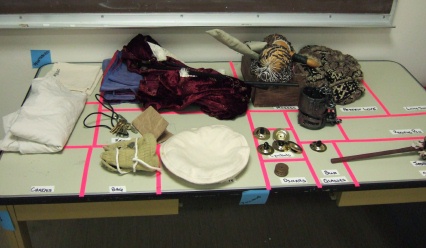
The actors ran through the dances in the “perfect love” story near the beginning, exposing me to some moments of jaw-dropping sensuality that left me convinced Steve Wojtas was the luckiest damn actor in Madison. (University Theatre’s stick-it-to-the-man print advertising for the show does promise a “sexual world,” after all.) The finer points of knife-threatening, shawl manipulation, and “bong timing” (as in a gong) were explored, and some pronunciations were clarified. Professor Saldivar polished the timing of the dialogue in an early scene and led all the actors through a very cool cacophonous scene that appears towards the end, one that concentrates Scheherazade’s storytelling power in a compelling way and that will probably be a highlight of the play.
 View originalOnce the preliminaries were done the actors went through the entire show without interruption, save for a break between the acts. The opening scenes establish Scheherazade’s predicament, with most of the play going to the stories. Like the source material, [i]Arabian Nights[/i] features stories within stories, with the roles of storytellers, listeners, and characters shifting. If you haven’t read Thousand and One Nights but did see “The Seemingly Never-Ending Story” episode of The Simpsons, this framing device should be familiar. The stories Zimmerman selected (I counted nine; actually nine plus six, which will make sense if you see the play) didn’t include well-known characters like Aladdin, Ali Baba, or Sinbad, but were nonetheless compelling and funny when they were supposed to be. There’s also the larger story of Scheherazade and the king, and his lessening hostility over time. And there’s a contemporary frame, one added by Professor Saldivar, that has a serious payoff at the end. Not just in its relation to a particular time and place but in its relation to the larger oral storytelling tradition.
Even with partial props and costuming this was a very satisfying experience and suggested a strong production. After another break the actors returned for notes from Professor Saldivar, which she recorded in a legal pad that was resting next to the script on a music stand. The next night, rehearsals would start in the Hemsley Theatre, with production stage manager Jen Murray taking on the Scheherazade-like role of the implementer of the story’s reality.
Performances for [i]Arabian Nights[/i] are 7:30 p.m. November 16 - 18, Nov 29 - December 2, and Dec 7-9. There’s also a 2 p.m. performance this Sunday only.
[b]Meet the masters[/b] View originalFall 2005 marks the start of a three-year cycle for UW-Madison’s MFA Acting program, whose students will become familiar faces over the next three seasons to regular University Theatre attendees. [i]Arabian Nights[/i] will have a full complement of talented performers.
Three of the MFA Acting students have appeared in local productions. Madison native [b]Stephanie Monday[/b] has been a “delightful” onstage presence since at least the late 90s, appearing in productions from just about every theater group in town, including Madison Repertory Theatre’s 2006 New Play Festival. [b]Olivia Dawson[/b], who comes to the MFA program after a decade of professional acting experience, played Susie in the Madison Rep’s 2000 production of [i]Wit[/i]. [b]Katheryn Phillips[/b]’ many Midwest credits include Dawn in the Rep’s 2003 [i]Lobby Hero[/i]. UW-Stevens Point graduate [b]Clare Arena Haden[/b] provides some additional Wisconsin representation, both in her alma mater and in her position as the education associate at American Players Theatre over the past summer.
Here’s one I haven’t seen before: [b]David Wilson Brown[/b]’s offstage credits include voice work for Funimation shows, including Dragon Ball Z. There’s no need to worry that Mr. Brown’s talents are limited to expressing incredulity about so-and-so’s power level or yelling over the course of 20-episode fight scenes, however: he’s also received a Dallas Theatre League nomination for Best Actor and has appeared in two of the “Abridged” shows created by the Reduced Shakespeare Company. [b]Jesse Michael Mothershed[/b] was part of an award-winning acting ensemble in a Hawaii production of [i]Angels in America: Perestroika[/i] and received a Best Director/Production “Alphie” for a one-act at the University of Arizona.
[b]Josh Krevsky[/b], who’ll have to tell us about the play [i]Zombie Prom[/i] some time, comes to Madison from Philadelphia, where he participated in a Young Playwright's Festival in that city for three years. Also making the trip from New England are [b]James Macon Grant[/b] (University of Maryland – Baltimore County graduate and Washington DC Fringe Fest), and [b]Steve Wojtas[/b] (graduate of Lehigh University in Pennsylvania and a native of Hampstead, New Hampshire). [b]Andy Rice[/b], who recently appeared in a film called [i]Vanish[/i], comes to UW-Madison from New York but has also trained at Playhouse West in Los Angeles. [b]Leia Espericueta[/b], meanwhile, whose resume includes the classic roles of Olivia ([i]Twelfth Night[/i]) and Nora ([i]A Doll’s House[/i]), is from Southern California. MFA Directing student [b]Talish Barrow[/b] joins the cast this time around, doing a very credible impersonation of an MFA Acting student as far as I could tell.
Here’s hoping the MFA students have a productive three years and attain their goals, whether they include playing their dream roles in professional productions, becoming artistic directors for theater companies, and/or being featured in an Isthmus cover story.
[b]Post script[/b] (added Nov 17)
[quote=Cap Times reviewer]Saldivar must have gone out for one too many smokes during rehearsal.[/quote]
While I don’t imagine the writer expected us to take this criticism literally, I wish it known that I did not perceive a lack of engagement in the production or any other kind of unprofessional behavior on the part of Norma Saldivar.