 View original[i][color=red][See the end of the story for my thoughts on seeing the performance.][/i][/color] Today at 8 p.m. is the second and final performance of Blitz VII, put on by Mercury Players Theatre at the Bartell, 113 East Mifflin Street. Tickets are $12, and if you go you’ll need to arrive early. The idea behind Blitz is that over the course of a 24 hour period, plays (including one musical each night) are created, cast, rehearsed, and performed for the public. You can have a look at Beckylicious’ Blitz observations from 2005 and check out some clips from RASH Films.
This year I participated in Blitz for the first time as a writer. I was a little surprised to learn that the writing gig for Blitz is in pretty high demand, given that it took me two years to work up the nerve to put my name forward. Gwen Quirk, author of “Lucky Numbers” from Mercury Rising was also in my group and Walmartopia creators Catherine Capellaro and Andrew Rohn are doing tonight’s musical. Some Blitz veterans from previous years aren’t in Blitz VII but will be in a special event in January called Blitz Smackdown, in case you’re a regular patron and are wondering where some of the usual suspects are.
[b]Background and preparations[/b]
The writing for Blitz involves some parameters that are given to the playwrights. Pre-defined titles are selected at random, where the titles all fit into a theme (for example, last year’s theme for the Friday plays was titles from American documents or figures, and Saturday’s theme was punchlines of jokes). To accommodate everyone who signs up to be an actor, playwrights also choose pre-defined cast sizes with specified numbers of male and female actors. And there’s one more parameter or challenge for playwrights to incorporate, such as a particular setting or prop.
You can have a look at Mercury’s history page to see what the challenges were for previous years. I did this as a way to prepare, to see what kind of plots I could come up with given those parameters, and some of them made me a little nervous. I didn’t envy Steven Van Haren’s charge to write a play called “The Last Full Measure” set onboard a spaceship for example, or Philip Heckman’s to create “Fear Itself” set at the largest ball of twine in the contiguous 48 states. Another thing I did to prepare was listen to selections of the soundtrack for [i]A Beautiful Mind[/i]; if you’re involved in a creative endeavor I commend the first 90 seconds of “A Kaleidoscope of Mathematics,” the first minute of “Creating ‘Governing Dynamics’,” and the middle third of “Cracking the Russian Codes” to your attention.
[b]The Blitz begins[/b]
I arrived at the Bartell at 7:30 p.m., where the playwrights for the Saturday performance were gathered at the Sarah Whelan Studio. My equipment included a laptop, two bottles of vitamin water and three music CDs in case I needed creative motivation: The [i]Beautiful Mind[/i] soundtrack, the original sound version soundtrack for [i]Final Fantasy IV[/i] (released in the U.S. as [i]Final Fantasy II[/i] for the Super Nintendo), and a Best of Saint-Saëns CD, mainly for Dance Macabre.
The first thing to do was select a pair of titles, since we were going to appear before that night’s audience and announce what we had selected. We would of course, only have to choose one but we would have an option of combining them, which is what I think Catherine and Andrew are doing. The two I chose were You Will Cry and Camel’s Foot. Some of the others included Clown Spikes, Sabot de la Vierge, and Austral Ladies Tresses. The theme, which I didn’t recognize, was orchids.
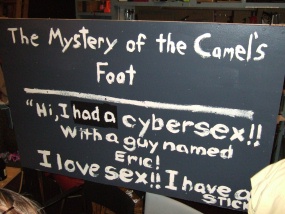
After appearing in front of the audience (full house) we went back to the Sarah Whelan to draw cast sizes and the additional challenge. That challenge was to work in the text of a note we were given along with a specific method in which the note was communicated. My method was the comparatively routine graffiti; other people had skywriting and “found inside someone.” The notes came from Found Magazine. Here’s the text of my note, which is written on Girls’ Best Friends Club stationery and is available for online viewing in its original format: “Hi, I had a cyber sex!! with a guy named eric! I Love sex!! I have a stick”
At this time we received some creative direction and advice from Rob Matsushita, a Blitz veteran who was serving as a mentor this time around for both nights. Some of the things he shared were common rookie mistakes as well as concepts that have been featured in multiple Blitzes and so may be worth avoiding; apparently people like their trapped-in-an-elevator and meeting-the-conservative-parents stories.
[b]The premise[/b]
Playwrights are allowed to switch challenges and I exchanged cast sizes with someone, so I had to write a play for 3 women and 5 men. I think the skywriting people were able to exchange their page-long note with someone.
I began by writing down the various ideas I had for the two titles. I came up with some for You Will Cry but none I could easily imagine occupying eight characters, or that really went anywhere. I had a fairly infectious idea for the Camel’s Foot one that sort of latched itself into my mind. One of the first things that came to my mind (after, you know) was the story “The Monkey’s Paw,” which got me thinking in the vein of 19th century adventure literature and, from there, Sherlock Holmes stories. Perhaps the Camel’s Foot was an artifact like the monkey’s paw, or else a jewel or other exotic object, or something like devil’s foot root in the Holmes story “The Adventure of the Devil’s Foot,” which is a plant root that drives people insane.
If multiple settings were practical in a Blitz production I might have done a series of scenes where a Holmes and Watson character talk to various iconic figures, like an old gypsy woman, in the pursuit of the Camel’s Foot mystery, giving me a chance to satirize genre conventions. I decided to consider the traditional conclusion of an Agatha Christie mystery instead, where the suspects were gathered in a drawing room. Except in this case, the setting would be modern day and the suspects wouldn’t appreciate the detective’s anachronistic methods. The drawing room convention would also give me a plausible reason to put a bunch of characters together. That was the basic setup, and by 11 p.m. I had something that looked like a script but was really more of a framework. The plan for the rest of the night was to fill it in and punch it up, so that it could go from being a moderately amusing premise to at least being a sketch.
[b]The process[/b]
You’re allowed to leave the Bartell if you want but spending all night in a theater is a little too good to pass up. So I stayed around and was pretty generous with myself about taking breaks. I occasionally checked in with the other playwrights as well. Around 12:30 Rob reviewed my draft and offered some helpful, specific suggestions. I appreciated how he got what I was trying to do with the premise and offered direction within that context, and was relieved that I wasn’t the only one who saw some potential for humor.
Around 2 a.m. I got my second wind, so to speak, which was another relief since I hadn’t done an all-nighter since my high school lock-in. Another review from Rob with some additional good ideas came at 3:30 a.m., and the script was ready (or as ready as it would ever be, I guess) around 6:15 a.m., by which time producers Pete Rydberg and Casey Grimm had arrived. So it wasn’t quite “24 hours from page to stage,” but more like 24 hours from brain to stage. I left my Saint-Saëns CD with the production team, since I had suggested opening the play with suspense music and thought something from early in Dance Macabre might work.
[b]Conclusion[/b]
If I had to characterize the script in one word it would be “tidy.” I wasn’t particularly ambitious with the material and didn’t really deviate from the framework, so the status updates I gave the RASH Films dude who was recording the playwrights were pretty lame. The script isn’t the funniest thing I wrote (that darn note is the funniest line of the play) but I was satisfied that I incorporated the note in a fairly unpredictable way.
Apparently each script has what Rob Matsushita called a “Blitz moment,” which reflects the strange places a writer takes him or herself over the course of writing a Blitz play. In my case, the #1 moment would probably be the speech that connects the title and the note but a close second would be the line towards the end “A-ha! As an English major, you have access to books, do you not? Books written in English?”
Some of the other scripts tonight will be about a clown war and a pirate ship. And the last I heard, the current president will play a prominent role in the musical.
[i]Yesterday I saw night 2 of Blitz and was quite satisfied with their production of my script, which was the first play of the night. I had a pleasant surprise when I opened my program and saw that J. Patrick, an experienced local actor, would be playing the protagonist. I hadn’t thought of him when I was writing the play but when I saw his name I realized he would be well-suited to the role.
I was very pleased with how the director, Schwag, filled out the play, adding details like the blackboard pictured below. Given the number of times I referred to specific text from the note, I probably should have thought of that myself. He also staged a very effective, dramatic opening that set the situation up well. There was some fun physical stuff going on and the cast got a few more laughs then I was anticipating. The play didn’t get the same amount of audience enthusiasm as the clown war play but, like I said, I was satisfied.
I had the chance to talk to Schwag afterwards and he seemed enthusiastic about the script. He mentioned that Patrick retrieved a bunch of stuff on his own for the role, including a magnifying glass and a Sherlock Holmes outfit. I also spoke with Kristin Bartel, whose role in my play had been her first acting experience. I liked what she did in the role and assured her that sarcastically imitating a suspenseful musical sting by saying “dun dun dun” rather than “bom bom bom,” as I had written it, was quite acceptable. That line got one of the bigger laughs, in fact.
If you go to Blitz next year and find that people are interrupting awkward pauses with the word “blimey,” know that the tradition had its start with the pirate play at Blitz VII.[/i]