



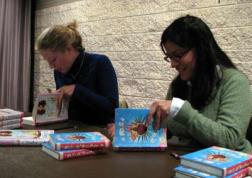
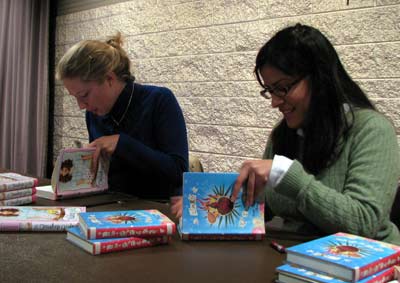
Two debut young adult novelists shared the Rotunda Studio stage Saturday afternoon for a small reading and Q&A that captured the challenges of writing authentically for a young audience.
Laura Schaefer, a Madison native, read from her book The Teashop Girls. The book's main character is go-getting 13-year-old Annie, who gets a job working at her grandmother's local teashop. However, she soon learns the independently-owned shop is in trouble, so she and her friends set out to save it.
Claudia Guadalupe Martinez, a native Texas now living in Chicago, read from her first book, The Smell of Old Lady Perfume. At the beginning of the school year, 11-year-old Chela Gonzales is convinced sixth grade is going to be the best year ever. But then her father gets sick, she misses the first week of school, and her best year starts to fall apart.
Both novels are written in the first person, and the authors did a superb job capturing these voices in print and in their reading. Schaefer's reading style highlighted her main character's sense of maturity, while Martinez whipped through her reading, capturing Chela's 11-year-old confusion and excitement.
Attendance for the reading was small, around 15 people, but the size allowed for an enthusiastic question and answer session from the audience. Both Schaefer and Martinez spoke eloquently about the challenges the found writing for a young audience and how they see their characters as role models for their readers.
Here are a couple questions and answers from the session (with a few minor book plot spoilers):
Question: The theme of the book festival is courage -- how do your books connect to that theme?
Laura: When I first started writing The Teashop Girls, I knew that one of the most important traits of the main character that I wanted to create would be a girl that acted, a very feisty person, the type who wouldn't take no for an answer. So when she finds out that her grandmother's shop is struggling, it doesn't even occur to her to do nothing or to just be sad. She's like, idea after idea after idea, and I think that's something that young people can be like because they don't know that sometimes there aren't happy endings. And so it's really fun to write for this age group because there's such optimism. My main character has courage because she doesn't even know any better. ... I want to keep that live in myself and encourage young people to be that way, to act in the world, and to never feel like they're too young to change something if they see an injustice or see something they don't like.
Claudia: For my book, essentially, it's not just a story of a girl who's father gets sick. You know, spoiler alert, her father eventually passes away and the second half of the book is basically how she deals with that and how she has the courage to still make this the best year ever for herself and still move forward and for her family to move forward and get past something very terrible that happens to them.
Question: What was the process like for you to speak from the perspective of a younger person, to be able to be so authentic in their emotions and voice?
Claudia: It's a lot of hard work. You have to pay really close attention to voice. I think it certainly helps to be around kids that are that age. I'm very lucky because I have eight nieces and nephews and about half of them are that age right now, so I was able to really interact with them and bring that back into the book. That is one of the hardest things, I think, for myself, to just really be able to be authentic with that voice.
Laura: I'm around a lot of kids now because I do school visits and library programs, but while I was writing the book I wasn't around a lot of kids so it was really me, my memories of what it felt like to be 13. For whatever reason, that's just really present for me. It doesn't' feel like that long ago and so I just tapped into my own memories writing in Annie's voice. My first version of The Teashop Girls I wrote in third person and the book didn't really work and start to come together and have that spark of life until I switched it into Annie's voice. I agree, it's challenging, but I guess I haven't been too worried about trying to match my writing to the outside reality. I want to make it my reality, you know, and if people connect to it, cool, I hope they do, but for me to be the most truthful is to write from my own experiences.