




Sit a four-year-old down in a room with a marshmallow. Tell them they can eat one marshmallow now, or, if they can wait for you to come back, they can then have two marshmallows. Leave for 15 minutes and see what happens.
This deceptively simple premise was the basis for a series of studies conducted in late 1960s at Stanford University by professor Walter Mischel. These studies have become seminal research on the idea of self-control and the brain processes that allow some people to put off immediate gratification in response to long-term goals.
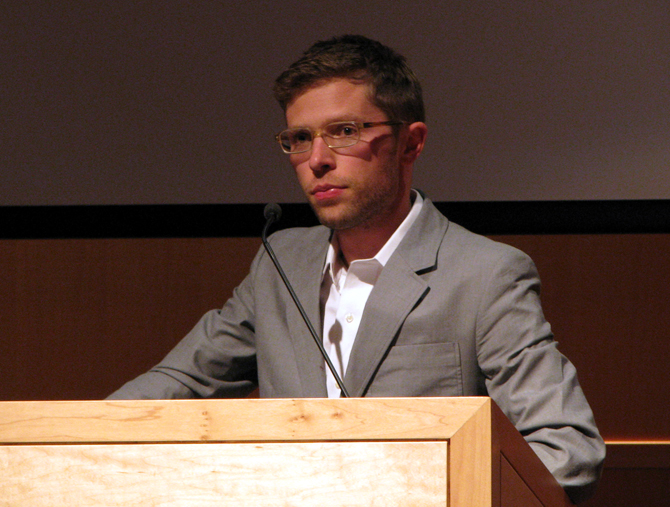
The study was also a major part of journalist, blogger, and author Jonah Lehrer's speech at the Wisconsin Book Festival on Thursday night called "From Marshmallows to Metacognition: What Can Science Teach Us About Decision-Making?" based on his newest book How We Decide.
The idea for How We Decide, Lehrer said, came from an everyday trip to the grocery store. While shopping, Lehrer and his wife realized they’d forgotten to get Cheerios. When Lehrer got back to the cereal aisle to grab the food, he became almost paralyzed with indecision; delicious HoneyNut Cheerios, fiber-filled Multigrain Cheerios, $1.99 generic cereal, or something else?
"A couple of minutes go by and I see, out of the corner of my eye, my wife looking at me like I've lost my mind," Lehrer confessed. "It was that everyday failure that led me to first become really interested in the subject of decision making and how the mind makes decisions and how the mind can make better decisions."
This personal style--taking science and making it seem more human--is a characteristic of Lehrer's work and was highlight of his address. My friend, a science journalist specializing in neuroscience and psychology, told me most of Lehrer's speech was familiar territory for him. However, the rest of the audience responded to Lehrer's self-deprecating sense of humor and ability to personalize scientific studies.
Based on his speech Thursday, I'm convinced Lehrer's skill as a journalist and speaker is based partially in the way he convinces his audience to participate in some meta-metacognition: thinking about how we think thinking about thinking. Smart.
The basis of decision making is a fundamental question in fields as diverse as the humanities, economics, and psychology. For a long time, as Lehrer explained, the idea of how to make good decisions was to be entirely rational, to take emotional responses entirely out of the process. However, psychological case studies of a patient who lost his emotional capacity indicated that he could be a terrible and indecisive decision maker.
"Our emotions don't just lead us astray," Lehrer said, "they're also an essential component of everyday decision making, and when you deprive the mind of emotions it can't make any decisions at all."
Intuition, instincts, and emotion--forms of knowledge from the unconscious brain that often get dismissed--can actually be profound ways of thinking. Lehrer outlined a series of studies which show that the brain's dopamine system--the part of the brain responsible for rewards--may play a role in our underlying knowledge systems.
However, relying entirely on emotional memory can also be a trap. Our gut reactions, based on synapse responses that make us feel good or feel bad, also can allow us to make errors in judgment if allowed to run without, well, critical thinking.
So if we know that the systems that underlie our emotional brain can be profoundly intelligent or, as Lehrer put it, "too stupid to realize" they're wrong, what do we do?
Well, we can think about our thinking, a process of what Lehrer calls "metacognition."
"[Metacognition] is a word I love and use way too much because it sounds really fancy and really smart and really intelligent but it's really the simplest thing in the world: It's thinking about thinking," Lehrer said.
He compared metacognition to "tip of the tounge syndrome," walking down the street, seeing someone you know, but being totally unable to figure out why you know them or who that person even is. This phenomenon happens pretty often, but Lehrer sees it as a profound brain process we all experience.
"How do we know we know something if we can't produce the memory? How do we know it's somewhere in there if we can't find it?" he asked.
It's this ability to think about thinking that is the basis for Lehrer's two suggestions for ways that science can help us think better--by making us more aware of the neurological biases our brain gives us and by making us better at controlling our own thought processes.
The first, which he covered more quickly, is to recognize that our brain is often loss averse and likes to avoid guilt. We can make more educated decisions if we know that the guilt our brain makes us feel from these decisions is an emotional response we should ignore.
The second technique, which is part of current, long-term research related to Mischel's marshmallow test, is to teach ourselves metacognitive skills to avoid distraction and make our brains more productive. By learning to focus our attention, we can put off the brain's pull for immediate gratification for more long-term rewards.
"By thinking about how I think," Lehrer concluded, "I can learn to think better."
Read-only archive. Accounts and comments are unavailable. Browse the archive.
featured