



The succinctly titled sign, "Geology Museum," tells only part of the story. The drawing of the mammoth hints at the other half. Open the glass door and go up one flight to step back eons in time. 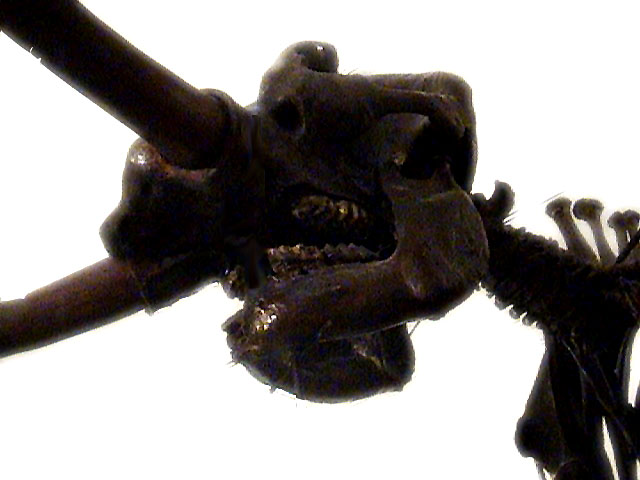 View original
Here lies the proof of life before God. The University of Wisconsin's geology and palenotology collections come from university expeditions and patron loans. The exhibits start off with an astonishing number of silica, mica, sediments, minerals, or rocks, as laypersons say. The cases bring solidity to the word "geology" in all its forms, a dizzying array of earth bits. There are a few moon chunks, too. Many pieces are striking in their recognizable pre-jewelry states. A darkened room sparkles with luminescent stones. A walk-though model cave settles the question: Stalactite or stalagmite?
A map of pre-glacial Wisconsin, without landmarks or byways, marks the entry of the time portal. The displays fill in the lifeforms which followed: fauna, insects, fish, and birds. And dinosaurs. High-school geology drifts back on tidy placards, Burgess Shale, Hell Creek Formation. Pre-Cambrian, Pliocene.
A wide window looks into the skeleton assembly room, and on the exacting reconstruction work being performed. Formal tours are available but wandering graduate students gladly share their obsessions.
Too many ages ago to count, to comprehend, the minute and humongous creatures here populated the world. The mind balks at the fact that beings so efficient, so strong, so well adapted – so permanent – were not.
Skeletons and skulls, wings and flippers, gaping jaws and slashing teeth and a T-Rex head mass together, striding out of prehistory. Armor bristles with all design of weird defensive protuberances. The largest human feels like prey beneath full-size edmontosaurus, ichthyosaurus, dinotherium and mosasaurus.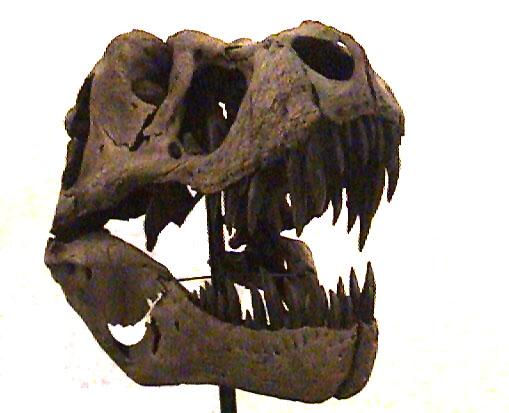 View original
One is named Stan. They all have names, say tour guides. The twisted cranial extensions and massive tusks suggest how easily less-informed palaeontologists unearthed legends of dragons and flesh-eating cyclops. Although planet-wide development is highlighted, Wisconsin's evolution is excellently represented. I discovered what happened to the misunderstood brontosaur. I learned the state fossil is the trilobite.
Millions of years live on an intimate scale in a few well-stocked rooms. The education is as fantastical or academic as you choose. Anatomy charts and Latin words abound. The thousands of bones, with models and dioramas, illustrate the picture for the less wordy time traveler.
Admiring murmurs and quiet gasps escape from unseen corners. Members of the wild kingdom look familiar from a nightmare. The nautilus shell is no smooth, beige emblem of the sea but a menace large as a donut tire and covered with three-inch spikes. Small jellyfish in a death pile look like angelhair and cantaloupe stew. A cute little mammal sports saber fangs and Freddy claws. The shark remains are a rarity, unlikely from a creature with no bones whose cartilage is typically consumed and composted post mortem. The museum's shark is has a belly full of its fossilized last meal.
The lobby houses a huge globe texturally detailing volcanos, fissures, trenches, desert reaches and mountain ranges. Its rotating girth casts the final perspective shadow. The earth is vastly uninhabitable to Homo sapiens, unwelcoming in its expanses of water. The United States of America is one small amount of land compared to the rest of the world.
To become insignificant, go to the UW Geology Museum at 1215 West Dayton (at Charter Street). Open Monday to Friday, 8:30 a.m. to 4:30 p.m. and Sat. 9 a.m. to 1 p.m. No admission.