



 View originalAs spring rolls gently across Madison, there is no better time to explore the wild side of the city. Drop a boat into Starkweather Creek.
It traverses the city in two branches, one starting by East Towne Mall and one from the west and the town of Burke, by and through the Dane County Regional Airport. Winding under picturesque bridge and intercity highway alike, the creek offers an easy and fascinating trip. It is not always for the faint of heart, or for those who insist their water be clean. In mosquito season the challenge can be insurmountable.
We put in just pass the Fair Oaks Avenue overpass on the near-east isthmus. The west branch is the straighter section of the creek, the more inescapably urban. Adventurers must face the most treacherous stretch, the tunnel beneath the six lanes of East Washington Avenue. I vote this section the one most likely to conceal a submerged corpse. The rest of our party long ago discovered the secret is to make as much noise as possible and enjoy the echo. I close my eyes, hold my breath if necessary, and paddle fast. Our reward is an unsettling quiet as we shoot out the other end.
There is no mistaking the proximity of traffic and population, ample cement proof of civilization pops up everywhere, but reaching, leaning trees blur reality. Varying with water height and downed debris, the trail ends not many yards ahead. The wealth of fish, muskrats and frogs, in addition to a generous sampling of insect and plant life, among the tumbled concrete blocks makes it worth the extra maneuvering required. A huge culvert blocks the way and the only option is to turn around.
The creek's character changes in many aspects throughout the year. Spring runoff adds special touches to water already full of chemicals from the airport and every lawn along the route. "This is the most disgusting I've ever seen it," Brian mutters from the stern. I've never seen it so thick with floating clods of unidentifiable matter, but the worst of it pools in a gentle bend and thins a few feet later. By next month the mass will disperse and settle as the water level rises from additional rain. More odd and smelly pseudo-organic globs appear during the year, prompting heated scientific debates among the crew.
This soft April evening, there is less litter than expected. Ducks silently crash land with startling regularity. Fellow boaters are few, most companions smile and wave from the bike path alongside the water. Shortly past the Fair Oaks Avenue underpass, a wide fork offers one way to Milwaukee Street, the other to Olbrich Gardens and then on to Lake Monona. Milwaukee Street's short and heavily-traveled bridge shelters dozens of swallow families which pack its girders with cone nests and wheel about in a frantic hunt for bug prey. It is too early for swallows now, but iridescent grackles and bobbing red-wing black birds keep up constant motion and song.
I haven't been Starkweather flotsam at this time of year and find new sights without the impediment of leaves and high grass. Bare tree branches shimmer with sunlight reflecting off the ripples below. Paddling the east-south segment of the fork, we see the isthmus' best contradictions laid visible, witness an uneasy truce between the wild and human spaces: Empty riverbanks are alive with greening sprouts and animal activity, an unlikely foreground for the hulking Garver Seed Factory shell. Railroad tracks glint as vigorously as the water's surface, a mirror of the path civilizations take. A path still followed in Starkweather by heron and sandhill cranes.
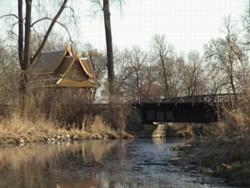
The Thai Pavilion's blazing presence beckons as we glide the final leg and face a test of physicality. Both railroad and bike path bridges are low. The water is never low enough. Only those able to lie, duck, or crouch rather flat, or who can push their boat down into the water without taking any on, can enter. In-line blades and tires rumble ominously overhead. Olbrich's elegant iron bridges, exotic trees and alien plantings serve as counterpoint to the untended grassland and industry silhouettes. But, the channel is often choked with milfoil and mined with snarled fishing line and spent bottles.
Madison's wet underbelly is a little-appreciated, living tribute to the manmade and natural forces which grudgingly accommodate each other. And it's an idyllic, if occasionally repugnant, way to spend time.