Legality of sign ban in question, extra crowd at Friday Solidarity Sing-Along unchallenged by Capitol police
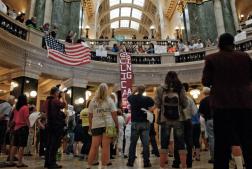
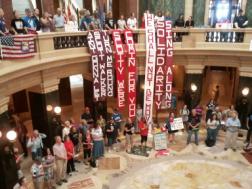
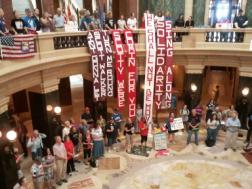
Friday’s lunch hour saw a larger and more energetic crowd than usual in the Capitol rotunda, as Madison residents showed up to join the Solidarity Sing-Along, hang banners, and hold signs in defiance of recent arrests.
After new Capitol police chief David Erwin vowed a crackdown on protest activity in the building last week, 12 people were arrested Wednesday and Thursday for holding signs without a permit, a violation, police told arrestees, of section 2.07(2) of the Wisconsin Administrative Code, which reads:
No displays, signs, banners, placards, decorations or graphic or artistic material may be erected, attached, mounted or displayed within or on the building or the grounds of any state office building or facility without the express written authority of the department.
Stacy Harbaugh, communications director for the ACLU of Wisconsin, was at the Capitol Friday as a legal observer, along with several attorneys from the National Lawyer’s Guild and other groups. She said turnout exceeded 150 people, and that police presence was limited to five or six officers for most of the afternoon. There were no arrests, she said. “We were all ready to witness a big crackdown,” she said. “Today was exciting in a really good way.”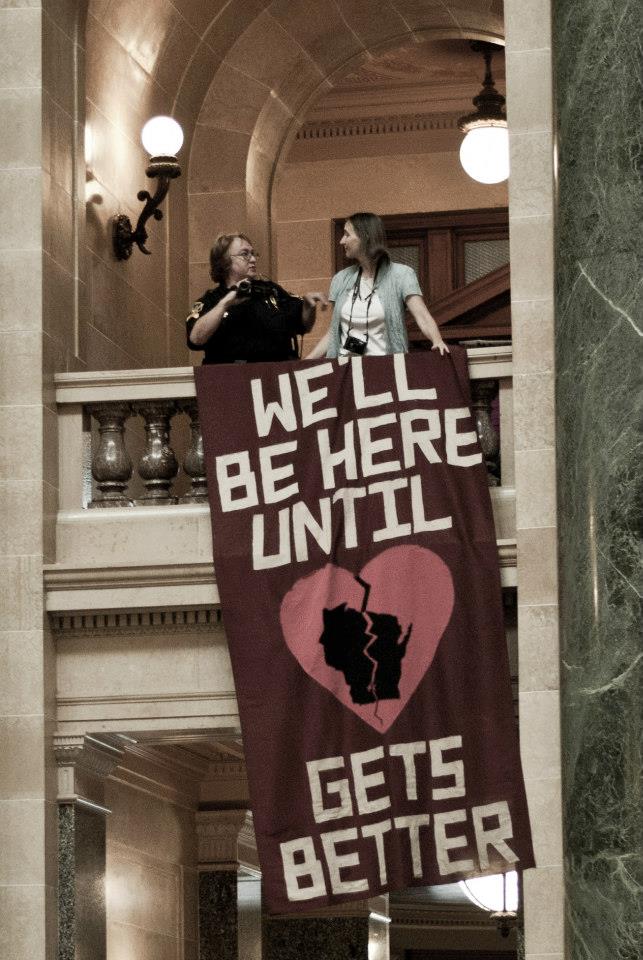
However, she said, the future of political expression in the Capitol rotunda was still murky, and the police had still not communicated important details about how they planned to treat different types of speech. “We need a little bit more clarification on what to expect,” Harbaugh said.
Protesters saw a legal ray of hope Thursday, in the text of Dane County Circuit Court Judge Frank Remington’s decision to dismiss a lawsuit brought by six protesters against the Department of Administration last year. Those protesters had also been arrested for holding signs. Although the dismissal of the lawsuit meant no relief for that particular case, Remington touched on the question of whether a person holding a sign counts as a “display” under the code, and ultimately rejects it.
“The term "displayed" implies something like afreestanding exhibit showcased in the Capitol, not an individual holding a handmade sign over their head comparing the governor to a character in a comic book,” Remington wrote. “...it is clear that the rule did not apply to the Plaintiffs' actions because their signs were not "displayed," but instead were held in their hands.”
Jeff Olson, whose firm represented the protesters in the suit dismissed Wednesday, said future lawsuits against the administrative code as a whole could still be successful. The problem this time was in the structure, not the validity, of the arguments.
“For future litigation, we’re going to have to be careful to pin the state down as to what provision or provisions of the administration code they pretend to be citing persons under,” Olson said. But he said the comment on displays, though not an actual injunction against arrests, should still have “an immediate impact on enforcement.”